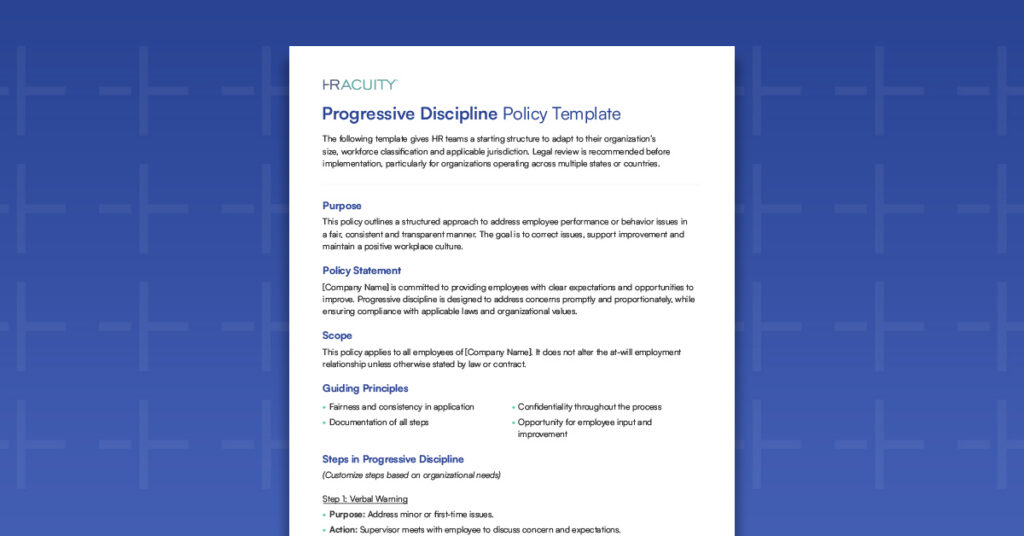
Done well, a progressive discipline policy helps your organization address workplace issues fairly, consistently, and effectively. Done poorly, it can expose your organization to avoidable legal risk.
Because your progressive discipline policy influences decisions ranging from coaching to termination, it’s imperative you establish a clear process before an issue arises.
This guide explains what progressive discipline is, the standard steps in the process and how to create a policy that can withstand scrutiny.
Key Takeaways: Progressive Discipline Policy
- Progressive discipline is a structured, documented process for addressing performance or conduct issues before termination becomes necessary.
- The standard model includes four steps: Verbal warning, written warning, final warning and termination.
- Serious misconduct (such as harassment, violence or theft) could bypass earlier steps and move directly to suspension or termination.
- Consistent, timely documentation helps support employment decisions if they are later questioned or challenged.
- A strong policy defines its scope, documentation requirements, escalation criteria, exceptions and ownership before an issue occurs.
What Is Progressive Discipline?
Progressive discipline is a structured corrective-action process that addresses employee conduct or performance issues through a documented sequence of increasingly serious responses.
At each stage, the employee receives clear notice of the concern, an explanation of the expected improvement and an opportunity to correct the issue before further action is taken.
It’s worth noting that progressive discipline practices will vary depending on your work environment. For instance, in a unionized workplace, it is especially important to work closely with your legal team when developing and implementing progressive discipline policies. You’ll want to note any situations in which the Collective Bargaining Agreement overrides the policies.
Why Use Progressive Discipline?
Progressive discipline gives clarity and structure for both employees and the organization. Employees get notice of performance or conduct concerns, clear expectations for improvement and a reasonable opportunity to correct the issue. At the same time, the organization creates a consistent record of the steps taken to address the problem.
The key, however, is consistency. Progressive discipline is only effective when it is applied fairly across the organization.
Consistent enforcement helps employees understand what is expected of them and reinforces that similar situations will be handled in a similar manner. It also gives managers and HR teams a reliable framework for documenting concerns and determining appropriate next steps.
The Four Steps of Progressive Discipline
Your progressive discipline policy will vary depending on what works for your organization. Many teams have a four-step policy. However, this isn’t the only path forward. For instance, some organizations include suspension as an optional step as part of (or after) the final warning before termination. Work with your legal team to determine what makes the most sense for your organization.
The process is sequential by design, with each step creating a record that supports the next action (if necessary). However, serious misconduct (such as harassment, violence or theft) may justify bypassing earlier steps and moving directly to suspension or termination.
Any exceptions to the standard sequence must be stated clearly in the policy. Managers and employees should not be left to infer when the organization may skip a step.
Step 1: Verbal Warning
A verbal warning is typically the first formal step in the progressive discipline process. It is different from informal coaching, routine feedback or a general performance conversation.
Although the warning is delivered verbally, the manager should still document it in the employee’s record. The documentation should include:
- The date of the conversation
- The specific issue discussed
- The change in behavior or performance expected
- The timeframe for improvement
- Any follow-up date or next step
Forgetting to document a verbal warning creates a gap in the record, making it difficult to demonstrate that the employee received clear notice of the concern. One way to handle this is to include an email from the leader to the employee recapping the conversation in the record.
The manager should note the conversation in their people leader support tool, such as managER. There, people leaders can also access just-in-time coaching and easily escalate the issue to employee relations, if necessary.
Step 2: Written Warning
A written warning formalizes the record when an issue continues after a verbal warning (or when the severity of the initial incident warrants beginning at this stage).
Your written warning should:
- Identify the specific policy, expectation or standard involved
- Describe the conduct or performance concern
- Reference any previous coaching or notice
- Explain the corrective action required
- Define the timeframe for improvement
- State the potential consequences of continued noncompliance
The manager and employee should generally sign the warning, and the completed document should be added to the case record.
Centralized employee relations documentation helps keep each warning connected to the employee’s complete case history rather than dispersed across individual managers, inboxes or personal files. If the issue escalates, HR should be able to review the full sequence of events without having to reconstruct the record after the fact. HR Acuity’s award-winning HR case management software helps streamline this process.
Step 3: Final Warning
A final warning communicates that the issue has reached a serious stage and that continued noncompliance may result in termination.
The documentation should:
- Summarize the issue and relevant history
- Reference earlier warnings by date
- State clearly that termination may be the next step
- Include measurable expectations
- Define the review period
- Explain how improvement will be evaluated
Because of the potential consequences, HR (and, when appropriate, legal counsel) should review the final warning before it is delivered. Common triggers for involving legal counsel include allegations of discrimination, harassment or retaliation; a potential termination for cause; high-risk or executive-level matters; and any threatened or pending legal claim — though each organization sets its own thresholds.
Potential Interim Step: Suspension
In some cases, organizations choose to include suspension as an interim step in their progressive discipline policy. There are two common approaches. Some organizations use suspension in conjunction with the final written warning, reinforcing the seriousness of the situation and, where appropriate, creating time to complete an investigation before deciding on next steps. Others treat suspension as a standalone step that sits between the final written warning and termination.
Neither approach is inherently right or wrong. What matters is that your organization decides deliberately how it will use suspension and makes that choice transparent in the policy — so the step is applied consistently across comparable situations and produces a defensible record if a decision is later questioned.
If you choose to include suspension in your policy, meet with the employee privately, along with their manager. Document the suspension thoroughly — including the reason, whether it is paid or unpaid (as permitted by applicable law), the duration and the potential outcomes, and store it in the employee’s case record alongside the rest of the disciplinary history.
Whichever approach you adopt, teams should periodically audit their disciplinary cases to confirm that suspension is being applied consistently with the policy and across comparable situations. Reviewing case data this way helps surface inconsistencies before they escalate into risk and reinforces the consistency that makes the entire process defensible.
Step 4: Termination
Termination is generally the final step in progressive discipline. The documentation developed during the earlier stages provides context for the decision and demonstrates the opportunities the employee had to address the issue:
The termination record should:
- Reference each previous warning by date
- Summarize the expectations communicated to the employee
- Document the employee’s failure to make or sustain the required improvement
- Include the outcome of any final HR or legal review
- Confirm that the decision is consistent with organizational policy and comparable cases
Incomplete or inconsistent records make your termination decisions significantly more difficult to explain and defend. Before proceeding, HR should review the full case history and ensure that the process was applied appropriately. This review should include a consistency check against how comparable cases were handled, and confirmation that no approved or legally protected absences — such as FMLA, ADA or jury-duty leave — were counted against the employee.
Want a gut-check how to handle employee termination the right way? Our guide to termination best practices will help.
Progressive Discipline Best Practices for HR
The effectiveness of a progressive discipline policy depends largely on how consistently it is applied and documented. Applying these best practices will set your team up to handle these situations consistently and correctly:
- Apply the Policy Consistently: Employees must be held to the same standards, regardless of their seniority, manager, location, tenure or performance in unrelated areas.
- Document Issues in Real Time: Managers (and HR) should document disciplinary conversations and actions as soon as possible, ideally the same day so the details are fresh.
- Train Managers Proactively: Many managers are asked to deliver a verbal warning before they have received meaningful training on the progressive discipline process. Give managers access to a people leader tool that supports coaching before their first progressive discipline conversation occurs.
- Differentiate Performance Issues & Misconduct: Performance and misconduct concerns require a unique approach, and some situations involve both — so there should be clear next steps for either. In every case, keep the focus on the performance and the behaviors rather than the person. This preserves objectivity and lets you frame the concern using the SBI model (situation, behavior and impact).
- Review the Policy Regularly: HR, legal and compliance teams should work together to review this policy regularly. A policy that doesn’t reflect how the organization operates in this current moment will cause more harm than help.
- Use ER Data to Spot Trends: Review disciplinary and case data across teams to surface hotspots — unusually high discipline rates or inconsistent outcomes— so leaders can be coached proactively before risk escalates.
How to Build a Progressive Discipline Policy
For HR teams creating a new policy or reviewing an existing one, this guide can be adapted to organizations of different sizes, industries and environments.
Please note: You should always review your proposed progressive discipline policy with your legal team for their input.
Define the Scope and Covered Conduct
Start by identifying who the policy covers. This may include:
- All employees
- Specific employee classifications
- Temporary workers
- Contractors
- Unionized or nonunion employees
The policy should also identify the types of issues it addresses, which may include:
- Attendance and punctuality
- Job performance
- Workplace conduct
- Policy violations
- Failure to follow procedures
- Insubordination
- Other forms of misconduct
Where different groups are subject to different requirements, the policy should explain those distinctions or direct readers to the applicable agreement or procedure. This must be explicitly stated.
Set Documentation Standards
Establish a consistent documentation standard for every stage of the process.
The policy should define:
- What information must be recorded
- Who is responsible for creating the record
- Who reviews or approves it
- Where the record is stored
- Who may access it
- How long it is retained
Documentation inconsistency is a common weakness in progressive discipline programs. When some managers maintain detailed records and others do not, your organization will have a hard time showing that a policy was applied consistently. And that creates avoidable legal exposure.
Retention requirements may vary by state, country and type of record. HR should check in with legal or compliance teams before establishing a retention period. Access controls and retention should also align with applicable data-privacy requirements, which increasingly differ by jurisdiction.
Establish Escalation Criteria and Exceptions
The policy should explain what may cause an issue to move from one stage to the next. Escalation may be appropriate when:
- The employee does not improve within the defined review period
- The same issue occurs again
- The employee does not comply with the corrective action
- A new but related concern arises
- The seriousness of the conduct warrants a higher level of action
In some cases, the offense is so serious that the organization can bypass a step (or more). These situations should be explicitly named.
Without clear exceptions language, managers may feel obligated to follow the full sequence even when an incident requires immediate action.
Communicate Employee Rights and the Right to Appeal
A progressive discipline policy should also tell employees what they can expect from the process. Some of what follows reflects commitments your organization chooses to make; other items are rights protected by federal, state or local law. Write and apply the policy so that discipline never penalizes an employee for exercising a legally protected right, and confirm the specifics with your legal team.
The policy should state that employees have the right to:
- Receive notice of the specific conduct or performance issue at each stage
- Respond to the concern before a final decision is made
- Access their own disciplinary records, in a manner that is aligned with your organization’s data-access process
- Raise concerns about how the policy was applied without fear of retaliation
- Appeal a disciplinary decision through a defined process
- Have the process applied without regard to race, color, religion, sex, national origin, age, disability, genetic information or any other legally protected characteristic
- Not be disciplined for exercising a legally protected right, such as taking protected leave or engaging in activity protected by law
Several of these rights are backed by law, not just policy. Under EEOC guidance, taking a materially adverse action — including a suspension or termination — against an employee because they engaged in protected activity, such as reporting discrimination or harassment or taking part in an investigation, is unlawful retaliation. Protected activity does not, however, shield an employee from legitimate discipline: You may still act on genuine, well-documented performance or conduct problems, as long as the reasons are independent of that activity. Clean, contemporaneous documentation is what distinguishes the two.
Discipline must also steer clear of legally protected absences. The U.S. Department of Labor is explicit that an employee may not be disciplined for using FMLA leave and that such leave cannot be counted against them under attendance or points-based policies. Before finalizing any action, confirm that no protected leave or accommodation is being held against the employee.
Your appeal process should include:
- How and when an employee submits an appeal
- Who reviews it (a manager not involved in the original decision, HR or a designated committee)
- The timeline for a decision
- Whether the disciplinary action is paused pending the outcome
Appeal and due-process requirements can also vary by jurisdiction and employment type; public-sector employees, for example, may be entitled to specific pre-disciplinary and appeal rights with defined deadlines. Confirm the obligations that apply to your workforce with your legal team and build them into the process.
A policy without an appeal path leaves employees with no formal way to challenge a decision they believe was applied unfairly. That gap can surface after termination, when the absence of an appeal option becomes part of a legal claim.
Require Acknowledgment at Each Stage
Every disciplinary action should include a documented acknowledgment step, separate from the record of the issue itself.
At each stage, the policy should require:
- The employee’s signature and date on the written record, or documented confirmation that the record was reviewed with them
- A clear statement that a signature confirms receipt of the document, instead of agreement with its contents
- A process for documenting refusal to sign, including a witness signature or manager note confirming the employee was presented with the document
- A method for delivering and acknowledging records with remote employees, such as electronic signature
Acknowledgment creates proof the employee was informed at every stage. Without it, an employee can later claim they were never told about the issue or given a chance to respond.
Assign Ownership and Approval Authority
Clearly define who is responsible for each part of the process.
The policy should explain:
- Who initiates disciplinary action
- When managers must contact HR
- Who drafts and reviews written warnings
- Who approves final warnings
- Who has authority to recommend or approve termination
- When legal or compliance review is required
Clear ownership reduces the risk that managers will handle early stages inconsistently and involve HR only after the issue has become more difficult to manage.
Build a Consistent, Defensible Progressive Discipline Process
A progressive discipline process is only as strong as the documentation behind it.
HR Acuity helps employee relations and HR teams centralize case records, standardize issue handling and maintain a clear, complete record from intake through aftercare.
With managER, HR Acuity’s solution for people leaders, managers get coaching, easy-to-use documentation tools and a direct path to HR when an issue needs to be escalated.
See how HR Acuity can strengthen your progressive discipline process. Get a personalized demo today.