
Key Takeaways: General Counsel’s Guide to Litigation Avoidance
- The Issue: An Employee Relations Blind Spot. Your organization likely suffers from a lack of centralized data on employee investigations. This governance gap leaves you vulnerable during discovery and regulatory audits.
- The Liability: Process Consistency. Without a structured system, you cannot prove consistency. In a litigious environment where the EEOC secured nearly $700 million in relief for victims of employment discrimination in 2024 alone, this documentation gap is a material weakness.
- The Cost of Defense: $160k Deductible. The average cost to defend an employment lawsuit is $160,000. That is the deductible you pay for the Blind Spot.
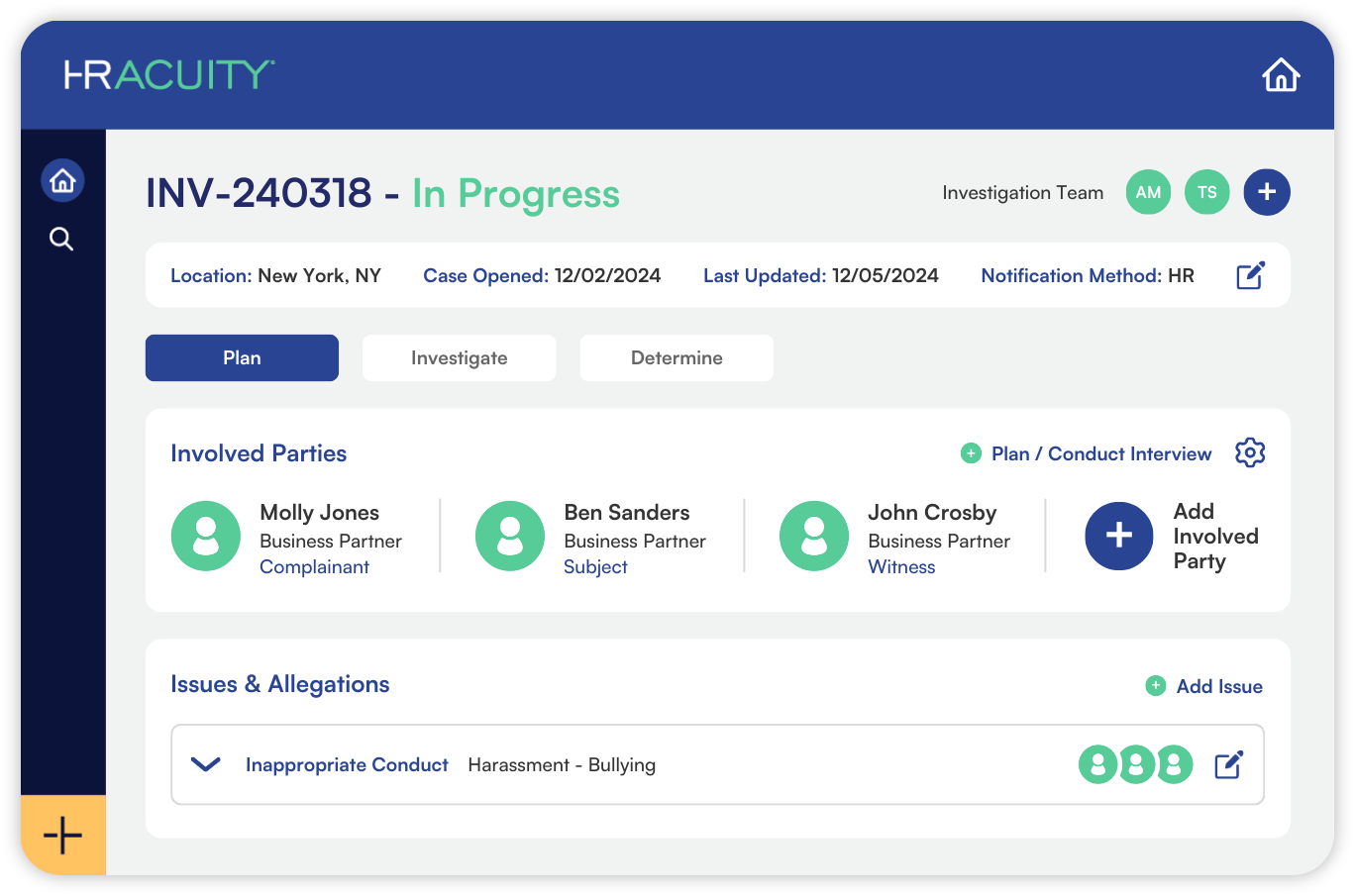
- The Solution: HR Acuity. Move beyond spreadsheets to a purpose‑built platform that ensures forensic fact‑finding, creating an audit trail that clearly demonstrates you treat employee issues consistently.
- The Mandate: Enterprise Risk Management. With misconduct claims hitting a record 14.7 per 1,000 employees, the General Counsel must elevate employee relations from an HR function to Enterprise Risk Management to satisfy fiduciary duties.
Let’s explore how.
The Governance Gap in Your Control Environment
Let’s face it: You already oversee rigorous systems for contract management, IP protection and financial compliance, yet the area with a great deal of inconsistency, human behavior, is often managed with the least rigor.
In many enterprises, sensitive investigation data lives in decentralized spreadsheets, disparate emails or the memories of local HR managers.
From a legal perspective, this is more than inefficient; it is a gap in governance. When a claim is filed, this gap becomes a significant liability. A spreadsheet cannot prove who edited a file and when. It cannot demonstrate a consistent, repeatable process across jurisdictions. In the eyes of a regulator or a plaintiff’s attorney, a governance gap is indistinguishable from negligence.
TLDR: Why is the Employee Relations Blind Spot a legal risk? The Employee Relations Blind Spot represents a failure of forensic fact‑finding. When organizations lack centralized, timestamped records of investigations, they cannot effectively defend against claims of discrimination or inconsistency. In litigation, the standard is often, “If it isn’t written down, it didn’t happen.” The Blind Spot forces settlements because the organization cannot produce the exculpatory evidence needed to effectively defend a case.
The Liability of Unstructured Data
The most dangerous document in a GC’s portfolio is often an HR spreadsheet. Here’s why:
Discovery Nightmare
Litigation is won or lost in discovery. If your employee relations data is fragmented, you face two risks:
- Inaccuracy: Spreadsheets are static and insecure. They show what was listed, not what was done — and they lack audit trails.
- Inconsistency Is Evidence. Without a centralized view, you cannot ensure that a manager in Region A disciplines harassment the same way as a manager in Region B. In a class‑action suit, that inconsistency is Exhibit A for the plaintiff.
Rising Cost of Defense
The cost of a single legal defense can easily exceed the total investment required for the software to fix your Employee Relations Blind Spot.
- Defense Spend: $160,000 for one employment lawsuit.
- Settlement Premiums. When you lack structured investigation data, you cannot assess merit quickly. You often settle to avoid the risk of what discovery might reveal — paying a premium for silence because you lack the data you need.
The Regulatory “Glass House”
Regulators are increasingly aggressive. The EEOC secured nearly $700 million for victims in FY 2024 and over $513 million in 2022. Their focus: Systemic failures, not isolated incidents. A lack of reliable data is essentially declaring institutional indifference.
Emerging Legal Horizons (AI & Whistleblowers)
- Whistleblower Risk: Transparency matters. 41% of employees share that knowledge of how similar situations were handled would convince them to report an issue. A clear and consistent employee relations approach allows concerns to be addressed before they build up. If the internal system is opaque employees go straight to the SEC or DOJ…which is what you want to avoid.
- AI & Algorithmic Liability: If an AI tool flags an employee based on biased data, the organization owns that bias. In court, “the AI made the decision” is not a defensible argument. Use of public large language models may also compromise attorney-client privilege. Effective governance and accountability over algorithms are simply non-negotiable.
HR Acuity: The Mechanism of Defensibility
- Forensic Fact‑Finding: HR Acuity moves investigations from ad‑hoc inquiries to forensic fact‑finding.
- The Standard: A platform that enforces a consistent repeatable workflow ensures every case is handled with the same rigor.
- The Outcome: Consistency proves fairness and transforms data from liability to a litigation shield.
- Early‑Warning System: You cannot govern what you cannot see.
- Visibility: 68
- Predictive Intelligence: Track yellow‑light deviations (minor policy issues) that precede red‑light events (fraud, harassment).
- Visibility: 68
- How HR Acuity Supports the General Counsel: By centralizing employee relations data and enforcing consistent workflows, your team can create a ready‑made defense, reducing reliance on external counsel for basic fact‑finding and strengthening your negotiating position in settlements.
The General Counsel’s Action Plan
- Audit Your Governance Gap.
- Inventory the risk: Where does investigation data live? If the answer is ’email’ or ‘SharePoint’, you have a gap. Workplace investigation software helps.
- Assess process consistency: Do you have a documented protocol that is followed 100% of the time? 32
- Establish Privileged Workflows.
- Manage the narrative by designating cases attorney‑client privileged from day one. (Your investigation software should have this embedded; HR Acuity does.)
- Drive root‑cause analysis: Shift employee relations from reactive to proactive prevention.
- Report Culture Risk to the Board.
- Reframe metrics. Swap engagement scores for internal‑control‑environment efficacy.
- Highlight substantiation rates and retaliation frequency.
The Employee Relations Blind Spot: Why Evidence, Not Intent, Determines Risk
When you cannot prove you did the right thing, the law often assumes you did the wrong thing. Adopt a platform that ensures forensic precision and you will do more than support HR. Instead, you’ll protect your reputation and build a more trusted workplace.
Your employees matter. Let’s get this right. Ready to learn how? Book a demo today and see HR Acuity in action.