
Since 2019, misconduct and harassment rates have significantly improved. Organizations updated their policies, invested in training and built out employee reporting infrastructure. As a result, progress followed.
Then 2025 hit. Fifty-five percent of U.S. employees experienced or witnessed workplace harassment or misconduct, a 14-point spike in a single year, resulting in a near seven-year high.
So what changed? And what does it tell us about where employee relations teams need to focus next?
Our latest misconduct research reveals new insights.
Case Volume Is Up, But So Is Complexity
More misconduct means more cases. But the data shows it’s more than a volume problem.
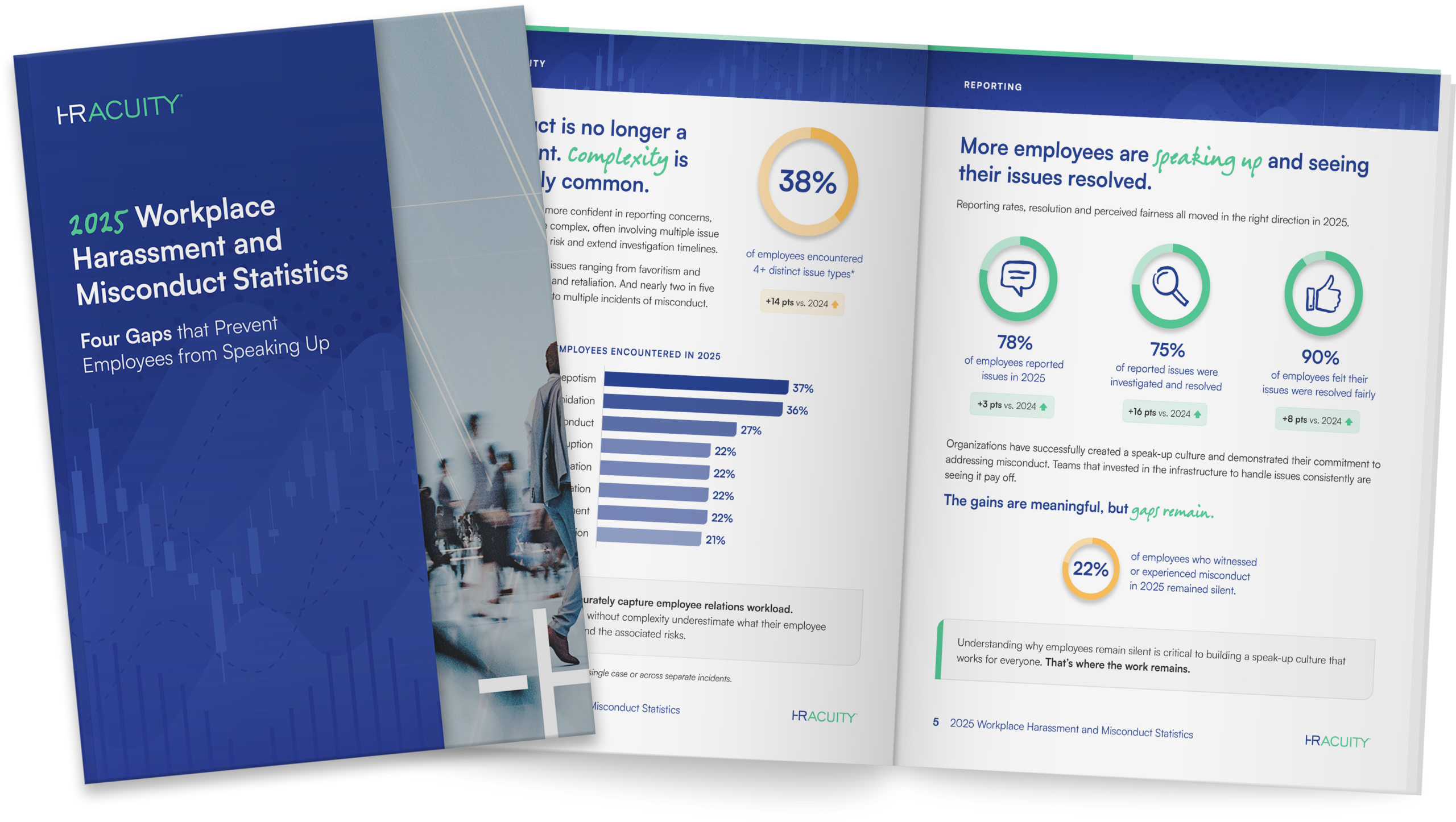
In 2024, 24% of employees encountered four or more distinct issue types of misconduct. In 2025, that increased to 38%.
Cases that once came in as a single allegation now arrive layered, such as a workplace conflict with a discrimination claim underneath, or a policy violation with retaliation undertones.
Complex cases take longer to investigate and increase legal risk, placing added strain on already stretched employee relations teams. Traditional case counts can’t accurately capture this workload, so a different approach to managing complex concerns effectively and minimizing legal risk is essential.
When cases commonly carry multiple dimensions, consistency, documentation and speed matter more than ever. Without them, risk compounds quickly.
Almost Every Organizations Offers Employees a Way to Report Concerns Anonymously, But Not Everyone Knows
Meanwhile, issues lie dormant in your workforce, only surfacing once they’ve escalated. That’s because 56% of employees don’t know that their organization offers anonymous reporting, even though nearly all employers do.
That awareness gap has a direct impact on how many people speak up. Employees who know anonymous reporting is available report at nearly double the rate of those who don’t (91% vs. 50%).
You’ve built the reporting infrastructure. Now, your job is to make sure your employees know it’s available and how to use it.
Employee Silence Follows a Pattern
The 2025 Misconduct Study reveals some good news, too. Employee issue reporting rates rose to 78% in 2025, up 20 points since 2023. That reflects years of investment in better processes, training and tools.
But 22% of employees who experienced or witnessed misconduct still said nothing. And once you dig deeper into which team members stay silent, the patterns are hard to ignore.
In-office employees report at lower rates than remote workers. Proximity, team culture and social visibility create friction that virtual environments don’t. Reporting rates outside the office are nearly 10 points higher.
The job-level gap is even wider. Only 63% of hourly employees report concerns, compared to 97% of executives, and concerns raised by hourly workers are 37% less likely to be formally investigated compared to executives.
The employees with the most exposure are the least likely to be heard. That’s where consistent investigation processes can make a real impact.
Employees Are Afraid of Retaliation, and For Good Reason
Forty-six percent of employees who didn’t report cited fear of negative consequences. The data suggests that fear is justified.
Only 46% of employees whose concerns were investigated say their employer monitored for signs of retaliation following the investigation.
No matter how strong your reporting system is, employees won’t use it if they don’t believe the organization has their back after they speak up, or if they don’t feel supported throughout the process.
The fix is straightforward, but often overlooked: Follow up, consistently and visibly. Look for employee relations software that builds aftercare and throughcare into the process.
The Cost You’re Not Measuring
We tend to measure misconduct in terms of legal exposure and case volume. Those matter. But there’s another cost that’s harder to quantify but hits your bottom line just as hard: Trust, and the turnover that results from losing it.
Fifty-five percent of employees said their trust in their employer declined after experiencing or witnessing misconduct or harassment, and many ultimately chose to leave. Among employees who left their organization after experiencing misconduct, 65% said it influenced their decision.
But it doesn’t have to be that way. When your investigations and aftercare processes work, trust can recover.
Employees whose issues were investigated and resolved became the organization’s strongest advocates. They were 14 points more likely to recommend their employer as a place to work than the average employee.
When your people see that concerns are taken seriously and thoroughly addressed, trust increases. When they don’t, it suffers.
What This Moment Actually Needs
Employee relations teams have built a solid foundation for handling misconduct over the past five years. The new Misconduct findings highlight opportunities for further improvements designed to handle the increasing volume and complexity that employee relations teams are facing.