
Your organization is falling victim to a logical fallacy: Treating employee relations issues and enterprise risk as if they are separate. They’re not. When legal and audit lack visibility into employee relations data, they miss the smoke before the fire.
Four Pillars of People Risk Defense: Key Takeaways
- Regulatory Reckoning: In September 2024, the U.S. Department of Justice’s updated Evaluation of Corporate Compliance Programs (ECCP) shifted employee relations from “nice to have” to prosecutorial evidence. The DOJ now expects organizations to show sophisticated use of employee relations data—how you access it, how you act on it and how you protect reporters. If you can’t demonstrate this, you face heightened indictment risk. If you can, you may earn penalty reductions of up to 75%.¹
- Financial Exposure: Fragmented employee relations documentation creates significant annual exposure — through various channels including litigation ($75K-$350K per case), turnover (125-150% of salary per mid-level exit) and productivity loss ($1.9M–$5.6M annually).² Centralized employee relations technology that standardizes investigations, documentation and analytics can generate a 520% ROI by transforming that exposure into a defensible process.³
- Intelligence Gap: Roughly 73% of harassment incidents go unreported, creating a “Trust Gap” that blinds leaders to the very risks most likely to destabilize culture and brand.⁴ At the same time, employee tips surface 43% of occupational fraud — more than any other detection method — yet 86% of audit professionals say data silos keep them from seeing the whole picture.⁵ Employee relations is the only system positioned to operate as an early-warning radar for culture, conduct and people risk, which is exactly why it’s an imperative part of a successful risk mitigation strategy.
- Fiduciary Mandate: The SEC’s $35 million Activision Blizzard settlement cemented a new expectation: Workplace misconduct is material financial information that must be properly captured and controlled.⁶ Boards now have a duty to ask for employee relations dashboards with the same seriousness as financial statements. Siloed employee relations data is no longer just inefficient — now, it’s a potential securities law problem.
1. The Regulatory Tsunami: The DOJ’s 2024 Compliance Reality Check
Data Access Mandate: From Policy to Prosecutorial Evidence
On September 23, 2024, the DOJ Criminal Division fundamentally changed the compliance conversation. The updated ECCP doesn’t just ask whether you have a program. Instead, it asks whether you can **access and analyze all relevant data in a “reasonably timely manner.”**⁷
For employee relations, that standard wipes out the old comfort zone of scattered spreadsheets and inboxes. When a prosecutor asks, “Show me all complaints about Manager X in Division Y,” answers like “We’ll need to pull from five spreadsheets, three email chains and a SharePoint folder” might as well be, “We don’t know.”
The ECCP is explicit: Compliance personnel are expected to make sophisticated use of data analytics to create efficiencies and measure effectiveness.⁸
What this means for your organization:
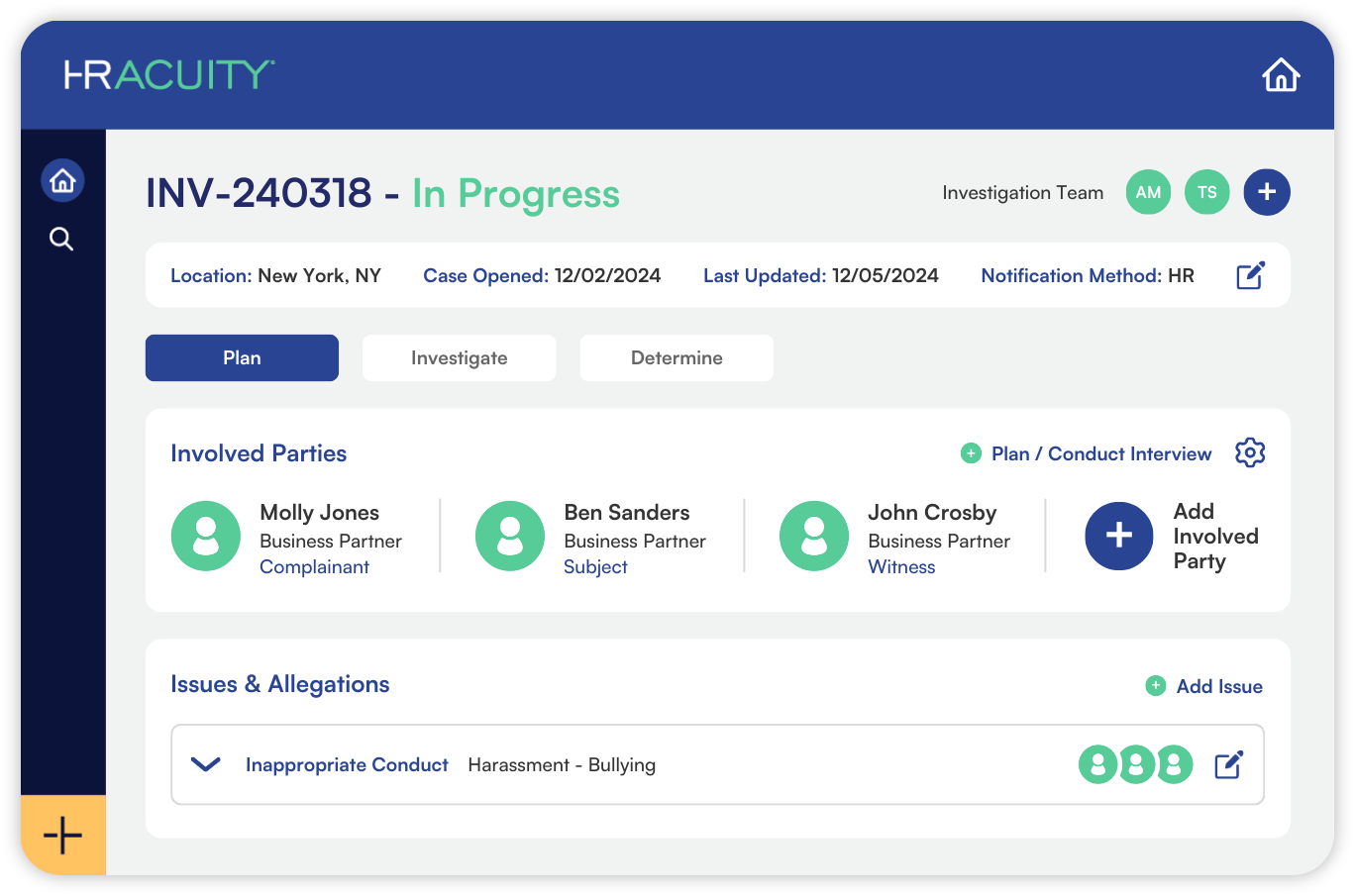
- Centralized case management is now non-negotiable. Today, a percentage of employee relations practitioners still track issues in spreadsheets.⁹ In the context of a DOJ review, that’s almost a direct admission that your program is not effective. You need a unified platform (think: HR Acuity, Resolver, Vault) that captures every complaint, investigation step and outcome in one auditable system of record.
- Real-time access or real-time liability: The ECCP expects organizations to show “knowledge of and means to access” relevant data.¹⁰ If a retaliation claim surfaces and it takes days or weeks to assemble a complete investigation file because pieces are scattered across HRBP laptops, you’ve already failed to meet the expectation.
- Data quality becomes a defense strategy: Prosecutors will ask how you control data integrity. Automated audit trails that show who accessed what and when are no longer nice-to-haves. Now, they’re essential to defend against arguments of spoliation or selective documentation.
Consequence Management and the End of Executive Impunity
The 2024 ECCP introduced a sharp new lens: Consistency of disciplinary action across all levels of the organization.⁴ The DOJ wants to know if your “zero-tolerance” policy is more than a tagline. Do executives and high performers face the same consequences as everyone else? That means you must be able to show, with data:
| Metric | Prosecutorial Expectation | Your Current State? |
|---|---|---|
| Substantiation rate by employee level | No disparity between executive and staff investigations | Do you track this? |
| Time-to-discipline by geography | Consistent application across regions | Can you prove it? |
| Disciplinary severity by manager | No pattern of leniency in particular teams or units | Is this data centralized and reportable? |
If your ER system can’t produce these analytics, you can’t prove fairness. And if you can’t prove fairness, you can’t credibly claim an “effective” compliance program.
The underlying message is blunt: Documented executive impunity is treated as organizational guilt.
AI Governance – The New Compliance Duty
For the first time, the ECCP instructs prosecutors to look at how you govern AI in compliance and risk workflows.²
If your employee relations or compliance team uses AI for case triage, sentiment analysis, pattern detection or flight-risk modeling, you will be expected to demonstrate the following:
- Pre-deployment bias testing: Has the model been tested for disparate impact on protected classes? If the algorithm is trained on historically biased data, it will amplify that bias — and your exposure.
- Human-in-the-loop oversight: AI can assist, but it can’t decide. Where AI influences a decision, you need a documented human rationale. “The algorithm flagged them” is not a defensible position in court.
- Continuous monitoring: DOJ wants to know how you “monitor and ensure technology’s trustworthiness.”¹¹ That translates to ongoing accuracy checks and regular (e.g., quarterly) bias audits.
Here’s the tension: AI can surface patterns humans might miss — like a manager whose team has three times the usual turnover. But if that manager sits in a protected class, your AI could be accused of profiling.¹³
Defensible AI requires clear governance — typically a cross-functional committee that reviews AI tools before deployment, signs off on use cases and logs decisions.¹² This committee should consist of legal, HR, IT, employee relations and ethics. To protect your organization and your people, creating a cross-functional committee to fill this gap is mission-critical.
Whistleblower Fortification vs. the “Chilling Effect”
The DOJ’s Whistleblower Awards Pilot Program creates a very real competition: Your internal employee relations channels are now competing with federal financial incentives to report externally.
If employees trust your process, they bring issues to you. If they don’t, they go straight to regulators — and you lose visibility and control.
The ECCP asks whether your company encourages reporting or unintentionally chills it.¹⁴ Typical chilling practices include:
- NDAs in separation agreements that restrict communication with regulators (now directly prohibited).¹⁵
- Disciplining reporters for minor policy violations uncovered during investigations.
- Failing to protect anonymity — especially when 73% of harassment victims cite fear as a reason not to report.⁴
The standard is rising: You are tasked with educating employees on their external reporting rights and must be able to demonstrate that internal reports are handled fairly, promptly and without retaliation.⁸
From an employee relations leadership standpoint, a 33% increase in hotline or case volume is not a problem — it’s a trust signal.¹⁶ It means people believe speaking up leads to action.
Clawbacks: Compensation as a Risk Lever
Under the DOJ’s compensation clawback initiative, companies that successfully claw back pay from wrongdoers can receive dollar-for-dollar penalty reductions.⁶
That effectively turns executive compensation into a risk management tool — but only if you have investigation files strong enough to withstand scrutiny.
Executives are unlikely to accept clawbacks without airtight documentation. A poorly documented investigation that leads to a clawback can quickly become a breach-of-contract dispute.
Robust employee relations case management tools — with clear chronology, evidence, findings and rationale—create the defensible record required to capture this potential penalty reduction.
2. The Economics of Silence: Quantifying the Trust Gap
Direct and Hidden Costs: The Multi-Billion-Dollar Drain
Workplace misconduct costs U.S.-based organizations an estimated $20.2 billion annually in direct costs, including legal fees, settlements and replacement hiring.⁴ But direct spend is only the visible slice. The real cost structure encompasses lost productivity, damaged brand and missed opportunities. Let’s dive in.
| Cost Layer | Metric | Annual Impact (500-Employee Org) | Source |
|---|
| Litigation defense | $75K–$350K per case; 97% EEOC win rate | $150K–$475K (2 cases) | ¹⁷,¹⁸ |
| Turnover | 125–150% of salary per mid-level exit | $4.2M (15% turnover at $75K avg) | ² |
| Productivity erosion | 10–30% loss from toxic culture | $1.9M–$5.6M (5% disengagement) | ² |
| Absenteeism | $1,685 per employee per year | $842K | ² |
| Stock price impact | 4.1% average drop on misconduct news | Market cap dependent | ¹⁹ |
| Regulatory fines | $14.82M average non-compliance cost | One event = catastrophic | ²⁰ |
| Brand/reputational | $2.71 penalty for every $1 of direct impact | Multiplicative loss | ¹⁹ |
For a 500-employee company without a centralized employee relations infrastructure, total annual exposure tops $7.1 million.² At 5,000+ employees, the same dynamics scale easily to $70+ million in unmitigated people risk.
The $8.9 Trillion Global Disengagement Tax
Gallup’s 2024 data estimates that disengagement — often fueled by unresolved conflict, fear of retaliation and lack of psychological safety —global economy $8.9 trillion, or 9% of GDP.¹⁰ And in the U.S. alone, the hit is $438 billion in lost productivity.¹¹
For CFOs, here’s the translation: If 30% of your workforce is disengaged because of culture or conduct issues, you’re effectively operating at 70% capacity before you account for operational inefficiencies. That’s EBITDA erosion no cost-cutting initiative can solve, because the root cause is human, not structural.
Escalating Litigation Awards and Today’s High-Exposure Verdict Environment
Employment cases are now seeing unprecedented, high-dollar verdicts.
Here’s what’s driving this:
- Social inflation: Juries are far less tolerant of “we didn’t know” defenses. One missed complaint can be framed as willful indifference to systemic culture issues.
- EEOC aggressiveness: The EEOC recovered $700 million for victims in FY 2024, its highest total ever, with a 97% litigation success rate.¹⁸
- Attorney fee multipliers: Prevailing plaintiff counsel can collect fees reaching $4.9 million per case, creating massive exposure even when the underlying award is modest.²¹
Insurers are responding. EPLI carriers increasingly require proof of centralized case management before underwriting. Organizations with ad hoc employee relations practices have seen premiums climb 40-60% since 2022. In severe cases, employers may find themselves effectively uninsurable.
Why Toxicity Is 10× More Predictive Than Pay
MIT Sloan’s research from the Great Resignation period found that toxic culture is 10 times more predictive of turnover than compensation.²⁴ You simply can’t out-spend or out-bonus a broken culture.
From an employee relations perspective, the red flags are often already visible in your data:
- If exit interviews reference “manager behavior” or “unresolved conflict” at three times the rate of pay concerns, your employee relations system is telling you where risk lives.
- Without centralized tracking, that signal is lost in one-off anecdotes.
- With a robust employee relations platform, you have quantifiable evidence to intervene before a leader’s behavior triggers a full turnover cascade.
3. The Strategic Pivot: Employee Relations as Enterprise Risk Intelligence
From Reactive Firefighting to Predictive Foresight
Traditional HR metrics tell you what already happened, such as turnover was 15% last quarter, engagement dropped three points and grievance volume ticked up.
Predictive employee relations analytics tell you what’s coming. For example, which manager’s team is likely to hit 25% turnover next quarter and why.
ER Maturity Model
| Level | Description | Risk Posture |
|---|---|---|
| Level 1–2: Reactive | Cases tracked in spreadsheets/email; no trend analysis | Maximum exposure; can’t prove consistency or spot patterns |
| Level 3: Trusted Veteran | Solid processes and basic tracking; operational but not strategic | Moderate exposure; can defend single cases, not systemic risk |
| Level 4: Strategic Advisor | Centralized platform, predictive analytics, board reporting | Minimum exposure; proactive interventions and defensible data |
Today, only 57% of organizations require a structured investigation process, leaving 43% in Level 1-2 territory.⁹ The DOJ’s 2024 guidance asks explicitly how you use data to “pressure test” program effectiveness — a question that’s nearly impossible to answer below Level 4 maturity.²⁵
High-impact predictive use cases:
- Hotspot mapping. A spike in “inappropriate communication” complaints in one division is often a six- to twelve-month leading indicator of a harassment claim.
- Flight-risk modeling. Tying ER interaction patterns to performance and tenure data can spotlight high performers at ~80% risk of exit, enabling targeted retention strategies.²⁷
- Sentiment analysis. NLP across exit interviews that shows “fear of retaliation” trending up 15% quarter over quarter is a flashing red light that your speak-up culture is eroding.²⁸
The General Counsel & CHRO Alliance: Breaking the Legal/HR Silos
Historically, General Counsel has “owned” defense while the CHRO has “owned” engagement. That split is now a liability. DOJ expects an integrated People Risk governance model.²⁹ That means your team will have to work together to mitigate risk.
What strong GC-CHRO alignment looks like:
- Shared KPIs, such as:
- Investigation cycle time (target: <21 days)
- Substantiation rate consistency (target: <10% variance by level)
- Post-investigation retention of reporters (target: >90%)
- Anonymous vs. named reporting ratio (target: <60% anonymous)³⁰
- Joint risk committee: At least monthly, legal, HR, employee relations, compliance and information security team members should review employee relations data together. A spike in complaints about Manager X should trigger:
- HR: Coaching, performance action or leadership change
- Legal: Privilege analysis and litigation readiness
- Compliance: Review for systemic bias or policy gaps
- InfoSec: Access-log review for insider threat indicators³¹
- Privilege protection: High-risk matters (such as executive misconduct or potential criminal conduct) need early legal involvement and clear “privileged” tagging in your employee relations platform, with restricted access that can be demonstrated.⁹
From a CFO vantage point, this alliance shifts spend from reactive defense (~$250K per lawsuit) to proactive prevention (~$100K annual tech investment) — a 5:1 ROI in year one.²
The Cyber-People Risk Nexus
By 2025, insider threats are projected to account for 60% of data breaches, with an average cost of $4.9 million per incident.³² Employee relations data is the missing behavioral signal in most cybersecurity strategies.
Integration playbook:
- UEBA + employee relations flags: When your User & Entity Behavior Analytics (UEBA) system flags an employee downloading 10× their normal data volume, cross-check:
- Were they recently passed over for promotion?
- Are they named in a harassment investigation?
- Did they recently file a complaint?
- Layering employee relations context onto technical telemetry can separate harmless anomalies from high-risk insider behavior.³³
- Workplace stress as a vulnerability: A 2025 study showed employees under “extreme workplace stress” are three times more likely to click on phishing emails.³⁴ Bullying, toxicity and overwork, all of which can be succinctly captured in employee relations data, are therefore direct cyber risk inputs.
- Exit interview intelligence: Departing employees who cite “unfair treatment” carry higher risk for data theft or malicious activity. Automated triggers to tighten or revoke access as soon as notice is given can close that window.
4. The ROI Imperative: A CFO’s Guide to Investing in Employee Relations Technology
The $7 Million Question: Mid-Market Exposure
For a 500-employee organization with an average salary of $75K, the numbers are straightforward.
Without centralized employee relations technology (annual):
- Turnover (15%): $4,218,750
- Litigation (2 cases): $150,000
- Absenteeism: $842,500
- Productivity loss from disengagement (5%): $1,875,000
Total: $7,086,250
With centralized employee relations technology (annual):
- Turnover (12% after 20% improvement): $3,375,000
- Litigation (1 case; 50% reduction): $75,000
- Absenteeism (15% improvement): $716,125
- Technology investment: $100,000
- Productivity gains (3% improvement): –$1,125,000
Total: $3,141,125
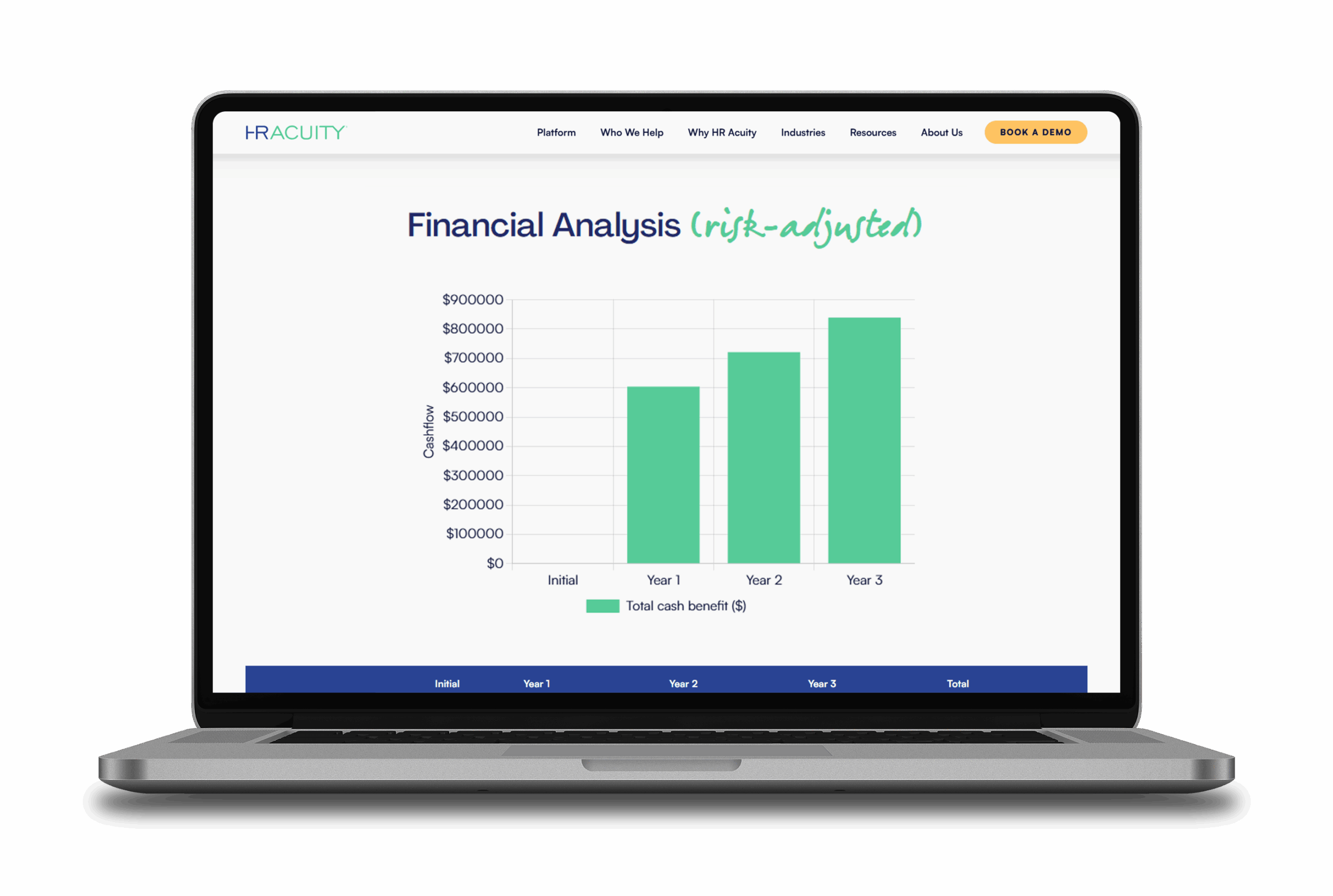
When you compare the technology investment against $2.4 million in avoided legal risk and costs, the ROI is 520% over three years.
Scenario Analysis: The Nuclear Verdict Variable
With the median nuclear verdict at $44 million in 2024,⁸ even low-probability events matter.
For a 500-employee employer:
- Baseline risk (no proactive employee relations):
- Nuclear verdict probability ≈ 1.0% annually
- Expected loss = $440,000
- Mitigated risk (with strong employee relations tech and demonstrable good faith):
- Probability ≈ 0.2%
- Expected loss = $88,000
That single risk reduction stream can pay for an employee relations platform more than three times over.
Cost Comparison – ER Tech vs. Traditional Risk Spend
| Risk Category | Annual Investment | Documented Loss Exposure | Investment Ratio |
|---|---|---|---|
| Cybersecurity | $500K–$2M | $4.9M average breach | 1:2 to 1:10 |
| EPLI Insurance | $92K–$409K | $75K–$44M per claim | 1:1 to 1:100+ |
| General Liability | $200K–$500K | Variable | Matched |
| Employee Relations Tech | $100K–$150K | $7M+ exposure | 1:70 |
Many organizations invest five to 10 times more in cyber controls than in employee relations, even though people risk exposure can exceed cyber by 40-60% in non-financial sectors.²
That’s more than just a budget quirk…it’s a capital allocation mistake.
5. The Defensibility Checklist: Your Regulatory Readiness Audit
Adapted from DOJ’s ECCP and EEOC enforcement priorities, this checklist helps you assess defensibility before regulators do.
Section 1: Centralized Data Architecture and Access
Regulator’s question: “How do you demonstrate access to all relevant compliance data in a timely manner?”¹⁰
| Checkpoint | Yes/No | Evidence Required |
|---|---|---|
| 1.1 Single repository for all complaints, investigations and outcomes | ☐ | Platform URL; user access logs |
| 1.2 Standardized intake form capturing date, parties, description and classification | ☐ | Intake template; audit of mandatory fields |
| 1.3 Automatic pattern detection (repeat offenders, location spikes) | ☐ | Algorithm documentation; sample alerts |
| 1.4 Role-based access controls (need-to-know only) | ☐ | Permission matrix; quarterly access review |
| 1.5 Ability to retrieve full case file within <24 hours | ☐ | Time-to-retrieve metrics; last five case audits |
Why it matters: With some employee relations teams still on spreadsheets,⁹ an inability to find files quickly in an EEOC or DOJ review reads as, “We failed to act.” Access is now a litmus test for program credibility.
Section 2: Investigation Workflow and Documentation
Regulator’s question: “Is there a consistent, documented process that every investigator follows?”⁹
| Checkpoint | Yes/No | Evidence Required |
|---|---|---|
| 2.1 Written investigation protocol (from intake through closure) | ☐ | Policy document; version control history |
| 2.2 Every step timestamped with date/user audit trail | ☐ | System logs; sample case timeline |
| 2.3 All supporting evidence attached to the case (interviews, emails, documents) | ☐ | Attachment rate >95% |
| 2.4 Final report template with factual findings, credibility assessments and rationale | ☐ | Report template; last 10 case reviews |
| 2.5 Substantiation rate tracked by issue type, level and geography | ☐ | Quarterly dashboards; variance analysis |
Why it matters: In employee relations, “If it’s not documented, it didn’t happen.”¹⁸ Inconsistent processes translate into discrimination exposure. Parity in substantiation rates across demographics is now a DOJ expectation.⁴
Section 3: Retaliation Prevention and Response
Regulator’s question: “What evidence shows you actively prevent and monitor for retaliation?”¹⁴
| Checkpoint | Yes/No | Evidence Required |
|---|---|---|
| 3.1 Anti-retaliation policy communicated to all employees and managers | ☐ | Training records; >95% acknowledgment |
| 3.2 Interim measures for high-risk cases (separation, reminders, modified reporting lines) | ☐ | Case notes; time-to-implement <48 hours |
| 3.3 Post-report monitoring of adverse actions for 6–12 months | ☐ | HRIS flag protocol; review logs |
| 3.4 Escalation path for retaliation allegations (direct to Compliance/Legal) | ☐ | Process map; last three case examples |
| 3.5 Anonymous reporting usage tracked and analyzed for trends | ☐ | Monthly volume reports; blind spot analysis |
Why it matters: Retaliation shows up in 51% of EEOC charges.⁵ One retaliatory act can create a separate violation — even if the original complaint was unsubstantiated. Monitoring must be proactive, not “let us know if something happens.”
Section 4: Oversight, Audit and Privilege
Regulator’s question: “Does the Board have meaningful oversight of compliance effectiveness?”⁴
| Checkpoint | Yes/No | Evidence Required |
|---|---|---|
| 4.1 Quarterly ER dashboard to the Board (cases, trends, hotspots) | ☐ | Board decks; executive session minutes |
| 4.2 Annual audit of investigation files (≥10% sample) | ☐ | Audit report; remediation plan |
| 4.3 Clear legal privilege protocol and triggers for counsel involvement | ☐ | Privilege logs; training materials |
| 4.4 Investigator training and certification recorded annually | ☐ | Curriculum; completion reports |
| 4.5 Document retention policy (min. 3 years post-closure) with legal hold detail | ☐ | Policy documentation; legal hold procedures |
Why it matters: “We didn’t know” is no longer an acceptable Board defense. The Boeing case highlighted that Board blindness is a fiduciary breach.⁸ Misusing or over-claiming privilege is a red flag; using it appropriately is a shield. Retention gaps open the door to spoliation arguments.
Section 5: Defensible AI and Analytics
Regulator’s question: “How do you manage the risks of AI in your compliance and ER functions?”²
| Checkpoint | Yes/No | Evidence Required |
|---|
| 5.1 AI governance committee reviews ER-related tools before deployment | ☐ | Committee charter; review minutes |
| 5.2 Documented bias testing for AI models (at least annually) | ☐ | Test results; false-positive/false-negative rates |
| 5.3 Human oversight required for AI recommendations, with audit trail | ☐ | Decision logs; override rate reporting |
| 5.4 Employee privacy impact assessment for analytics use cases | ☐ | DPIA documentation; consent records |
| 5.5 Accuracy metrics tracked (AI suggestion vs. actual outcome) | ☐ | Performance dashboards; tuning logs |
Why it matters: “Defensible AI” is rapidly becoming a baseline expectation.⁸ Using AI in employee relations without formal governance leaves you open to algorithmic discrimination claims — likely the next wave of class actions.
6. Implementation Roadmap: From Fragmentation to a Single Source of Truth with Employee Relations Technology
Phase One (30 Days): Current-State Audit and Data Architecture
Goal: Establish baseline risk and select the right technology.
- Data mapping: Inventory every employee relations data repository, such as spreadsheets, email, HRIS notes, SharePoint and paper. Count active cases and historical records, and track how long it takes to access a full file. Identify the “golden source” for each key data element.
- Stakeholder interviews: Engage general counsel, CHRO, compliance and internal audit. Document pain points and current “time-to-retrieve” metrics. Anything above two hours is a high-risk indicator.
- Technology selection: Issue an RFP for case management platforms that include:
- Strong audit trails
- SOC 2 Type II certification
- AI bias testing documentation
- Integration with HRIS and IT ticketing systems
- Data migration plan: Prioritize open investigations and high-risk historical matters (executive-level, retaliation cases) for immediate upload. Maintain chain-of-custody logs for all migrated content.
Phase Two (60 Days): Process Standardization and Training
Goal: Build and enforce consistent investigation protocols.
- Policy rewrite: Update investigation procedures to align with DOJ ECCP 2024 requirements, including AI governance, retaliation monitoring and Board reporting cadence.
- Training rollout: Certify investigators (HRBPs, employee relations specialists and legal) on:
- Documentation standards (e.g., all contacts logged within 24 hours)
- Privilege triggers
- AI tools and bias awareness
- Retaliation risk indicators and protections
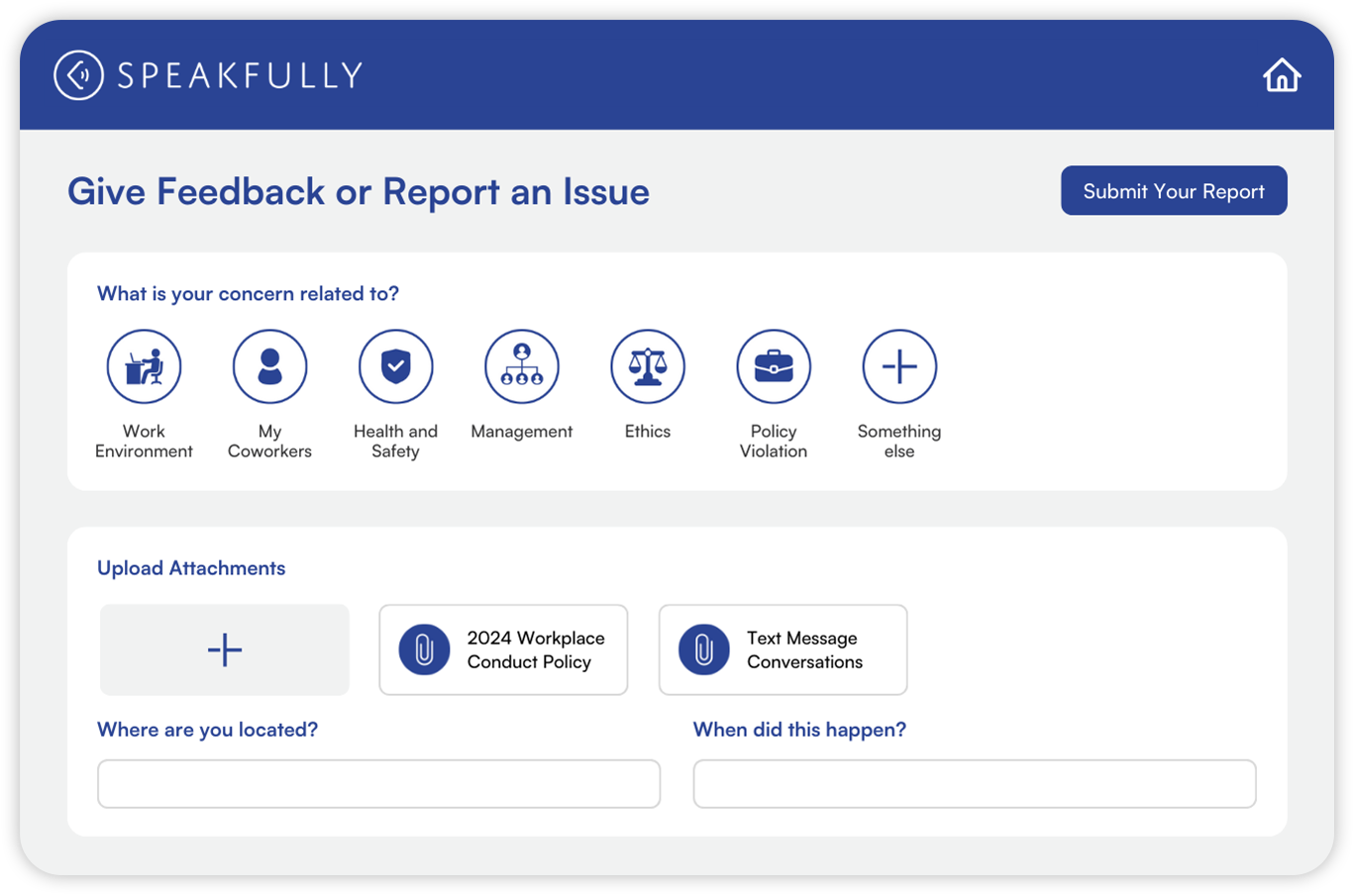
- Intake redesign: Launch a standardized web intake form and route submissions directly into your employee relations platform. HR Acuity’s whistleblower solution, Speakfully, gives employees multiple ways to voice their concerns — and seamlessly flows every report into your HR case management platform.
- Quality gates: Add peer review for high-severity cases before closure. Require joint sign-off from employee rerelations leadership and legal for substantiated executive misconduct.
Phase Three (90 Days): Governance Integration and KPI Alignment
Goal: Embed employee relations into enterprise risk governance.
- Board dashboard. Build a quarterly “People Risk” deck with:
- Case volume by type and location
- Substantiation variance analysis
- Retaliation allegation trends
- Hotspot heat maps
- AI performance and governance metrics
- GC-CHRO charter: Formalize joint accountability for investigation quality, retaliation prevention and consistent consequence management.
- Cross-functional committee: Hold monthly risk triage sessions with HR, legal, employee relations, compliance and IT security using predictive analytics to identify high-risk managers and departments.
- Compensation integration: Partner with the Compensation Committee to embed conduct metrics (investigation outcomes, consistency of discipline) into executive incentive plans.
Phase Four (120+ Days): Predictive Analytics and AI Deployment
Goal: Move from reactive case handling to predictive risk management.
- Baseline analytics: Use historical data to identify:
- Manager-level substantiation outliers
- Departmental complaint velocity
- Correlations between employee relations case volume and turnover
- AI governance framework: Stand up an AI committee spanning legal, HR, employee relations, IT and ethics. Approve pilots for:
- Case-priority scoring (with mandated human overrides)
- Sentiment analysis of exit interviews
- Hotspot prediction models
- Continuous improvement loop: Review AI performance quarterly — accuracy, bias indicators and investigator feedback — and retrain models on adjudicated cases.
- Regulatory simulation: Run a mock DOJ audit using your Defensibility Checklist, ideally with outside counsel, to stress-test your documentation and access controls.
7. Case Studies in Cultural Failure
Boeing – When Silence Becomes a Safety Risk
The failure: FAA audits in 2024 found that Boeing’s “Seek, Speak & Listen” program existed largely on paper. Employees feared retaliation for raising safety concerns. The audit documented a 37% failure rate in key manufacturing control tests, driven in part by a culture where workers didn’t feel safe speaking up.⁸
The consequence: Catastrophic crashes, the door-plug incident, more than $35 billion in losses and criminal scrutiny. The Board’s claim that it “didn’t know” didn’t hold up — there was no employee relations infrastructure to prove the company had been listening.
The lesson: Safety risk is people risk. When your employee relations strategy doesn’t protect whistleblowers, it directly undermines product safety and public trust. DOJ now treats cultural suppression as a material governance failure.
FDIC: The Regulator Regulated
The failure: An independent review found that the FDIC — the agency responsible for banking stability — harbored a toxic culture marked by sexual harassment and discrimination. Leadership’s responses were described as “insufficient and ineffective,” and senior officials faced little to no consequence.⁹
The consequence: The agency’s credibility took a serious hit, and retention suffered. The fact that a regulator failed to meet the standards it enforces underscored a broader truth: No institution is immune to culture risk.
The lesson: “Tone at the top” doesn’t mean much without “conduct in the middle.” Without strong employee relations systems and accountability mechanisms, policies quickly become performative. DOJ’s 2024 guidance pushes Boards to take direct responsibility for closing that gap.
Activision Blizzard: The $35M Disclosure Failure
The failure: The SEC charged Activision Blizzard with failing to maintain adequate controls for collecting and analyzing employee complaints. The company’s separation agreements also required employees to notify Activision before speaking with regulators, a clear violation of whistleblower protections.¹⁵
The consequence: A $35 million penalty — not for the misconduct allegations themselves, but for disclosure control failures.
The lesson: Employee relations data has crossed firmly into securities law territory. Fragmented documentation is now a potential 10(b)-5 issue. To regulators, siloed employee relations data looks like a breach of fiduciary duty to investors.
8. Board and C-Suite Frequently Asked Questions (FAQs): 15 Critical Questions Answered
For CFOs
- What’s the ROI for employee relations technology?
When you compare the technology investment against $2.4 million in avoided legal risk and costs, the ROI is 520% over three years. - How does employee relations technology affect insurance costs?
EPLI carriers increasingly offer 20-30% discounts when companies can show centralized case management and consistent discipline. In many cases, these controls are now prerequisites for coverage.²³ - Can we fund employee relations technology from risk or compliance budgets instead of HR?
Yes. DOJ and SEC guidance now frame employee relations data as enterprise risk infrastructure, on par with cybersecurity. Many organizations allocate funding from D&O, compliance or risk budgets.
For General Counsel
- Does centralizing employee relations data risk waiving privilege?
Not if you design it correctly. Use role-based access, privileged matter tagging and clear protocols that designate legal as the investigation owner for high-risk cases. Conduct regular privilege audits.⁹ - How should we respond to a DOJ request for “all complaints about Manager X?”
By producing a complete, time-stamped, audit-trailled export from your single source of truth within 24 hours. Fragmented data delays or gaps signal an inability to comply and raise prosecution risk.¹⁰ - What if an AI tool flags an employee in a protected class as high risk?
Human override is mandatory. Document the AI’s suggestion, your independent assessment and the final decision. That record becomes the backbone of defensible AI practice.²
For CHROs
- How do I convince a skeptical CEO to invest in employee relations tech?
Start with the numbers: $7M in exposure vs. a $100K investment and a 520% ROI validated by Forrester. Frame the solution as risk infrastructure, not “HR software.”² For more information regarding ROI, visit HR Acuity’s ROI calculator.²⁶ - What training do investigators need?
At minimum, annual certification in documentation, bias mitigation, privilege, AI oversight and retaliation detection — tracked like any critical compliance requirement. Prosecutors are already asking for this.⁹ - How do we measure “speak-up culture”?
Focus on metrics like anonymous vs. named reporting ratio, post-report turnover and time-to-closure. Strong programs typically target <60% anonymous reporting and <10% turnover among reporters.³⁰
For Board Directors
- Is employee relations data material for disclosure purposes?
Yes. The SEC’s Activision Blizzard settlement confirms that workplace misconduct can be material to investors. Weak employee relations controls quickly become a disclosure issue.¹⁵ - What should we see on the Board’s employee relations dashboard?
At a minimum: Case volumes, substantiation rate variance, hotspot analysis, retaliation trends and AI governance metrics — reviewed in executive session at least quarterly.⁴ - Can we be personally liable for cultural failures?
Potentially. Under Caremark, Boards must ensure that adequate reporting systems exist. Failing to demand employee relations data can be interpreted as a breach of your oversight duty.⁸
For Compliance Officers
- How does employee relations data fit into ERM frameworks like COSO or ISO 31000?
Treat people risk as a primary risk category. Map employee relations KRIs — substantiation rates, investigation cycle times, retaliation incidents — to enterprise risk appetite statements. Review these alongside other risk metrics in your cross-functional risk committee.⁴⁷ - What’s the minimum retention period for investigation files?
Generally, three years post-closure or employee separation, whichever is longer, with legal hold procedures for any pending matters.⁹ - Can we use AI to screen employees for misconduct risk?
Only with documented bias testing, explicit human oversight and appropriate consent. You must comply with emerging state AI laws (such as NYC and Colorado). Without strong governance, you’re inviting EEOC and regulatory scrutiny.²
Works Cited
- DOJ Updates Guidance for Evaluation of Corporate Compliance Programs, Covington & Burling (Sept 2024) – Link
- Institute for Legal Reform, “Nuclear Verdicts Study” (May 2024) – Link
- Forrester Total Economic Impact Study: HR Acuity ROI (2023) – Link
- Vault Platform, “The Trust Gap” (2024) – Link
- Association of Certified Fraud Examiners, “Occupational Fraud 2024” – Link
- Miller & Chevalier, “SEC Signals Workplace Misconduct is a Disclosure Issue” (2023) – Link
- U.S. Equal Employment Opportunity Commission, FY 2024 Performance Report – Link
- Occupational Safety and Health Administration, 2024 Penalty Structure – Link
- HR Acuity, “Employee Relations Benchmark Study” (2024) – Link
- U.S. Department of Justice, Evaluation of Corporate Compliance Programs (Sept 2024) – Link
- Good Jobs First, “The High Cost of Misconduct” (2024) – Link
- Ethisphere Institute, “2024 World’s Most Ethical Companies” Methodology – Link
- HR Acuity, ” AI & Compliance: A Practical Guide for Employee Relations Teams” (2025) — Link
- LRN Corporation, “The Cost of Bullying, Harassment, and Misconduct” (2024) – Link
- Society for Human Resource Management, “Toxic Workplace Culture Cost” (2024) – Link
- Mitratech, “2025 State of Ethics Hotlines Report” – Link
- Novian Law, “Average Cost to Defend Employment Lawsuit” (2025) – Link
- Workplace Class Action Blog, “EEOC Issues Annual Report” (2025) – Link
- PMC, “Reputation Damage from Misconduct” (2024) – Link
- Corporate Compliance Insights, “True Cost of Compliance” (2024) – Link
- Proskauer, “Prevailing Employees Counsel Entitled to $4.9M Fees” (2025) – Link
- ACT Research, “Predictive Analytics in HR” (2025) – Link
- WTW, “Employment Practices Liability: 2024 Year in Review” – Link
- MIT Sloan, “Toxic Culture Driving the Great Resignation” (2022) – Link
- HR Acuity, “From Insight to Foresight” (2024) – Link
- HR Acuity, “ROI Calculator” — Link
- Vault Platform, “Workplace Discrimination Cost” (2024) – Link
- SHRM, “Employee Engagement ROI” (2024) – Link
- Heidrick & Struggles, “CHRO-GC Collaboration” (2024) – Link
- Aon, “Integrating Cyber Risk into ERM” (2024) – Link
- InfoSecurity Magazine, “Talent and Governance in Age of AI” (2024) – Link
- IBM, “Cost of Data Breach Report” (2024) – Link
- DAU, “Examining Risk Management Failures: Boeing 737 MAX” (2023) – Link
- FDIC Office of Inspector General, “Special Inquiry of FDIC Workplace Culture” (2024) – Link
- Miller & Chevalier, “SEC Signals Workplace Misconduct Disclosure Issue” – Link
- KPMG, “Counting the Cost: Workplace Bullying” (2024) – Link
- HR Acuity, “HR Risk & Compliance Management Software” – Link
- ASHRM, “Enterprise Risk Management: Implementing ERM” (2024) – Link
- ResearchGate, “The Biggest Gap in ERM Practice: The Human Element” (2022) – Link
- Resolver, “4 Ways Employee Engagement Affects Risk Management” – Link
- Covington & Burling, “DOJ Updates Guidance on AI and Whistleblower Protections” – Link
- Harvard Law School Forum, “Key Updates to DOJ’s Evaluation of Corporate Compliance Programs” – Link
- GALLUP, “State of the Global Workplace Report 2024” – Link
- FBI, “Insider Threat Program Development” – Link
- LRN Corporation, “2024 Ethics & Compliance Program Effectiveness Report” – Link