Enterprise risk is any threat that could prevent an organization from achieving its objectives. The scope is broad by design. Regulatory failures, data breaches, supply chain disruptions and employee misconduct all fall under the umbrella.
Enterprise risk management (ERM) is how organizations get ahead of those threats. It provides the frameworks and processes used to identify, assess and address risks systematically, across every department, not just the ones that feel exposed. The difference between organizations that weather crises and those that don’t often comes down to whether ERM is embedded before something goes wrong.
We’ll explore practical enterprise risk examples and enterprise risk management examples in action, giving you a clear picture of what organizations actually face and how high-functioning ERM programs respond. If you’re focused on mitigating risk at the organizational level, these examples are a useful starting point.
Key Takeaways: Examples of Enterprise Risk & ERM
- Enterprise risk is any threat, internal or external, that can undermine strategic, operational, financial or regulatory objectives across the organization.
- Enterprise risks differ from departmental risks in their reach. They cross functional lines and require coordinated governance, not just a local fix.
- Common categories include operational, financial, compliance, cybersecurity, strategic and workforce & conduct risk, and they often compound each other.
- Enterprise risk assessment uses likelihood and impact scoring to prioritize which threats demand the most immediate attention and resources.
- ERM programs operationalize risk management through dashboards, risk registers, governance frameworks and cross-functional reporting.
What Is Enterprise Risk?
Enterprise risk is any threat, internal or external, that could undermine an organization’s ability to meet its strategic, operational, financial or regulatory objectives.
These risks don’t follow org chart lines. A single cyberattack can simultaneously compromise operations, trigger regulatory scrutiny and erode investor confidence. That breadth is what distinguishes enterprise risk from a typical business problem. Because of this, the response can’t stay inside one department.
What’s the Difference: Departmental Risk vs. Enterprise Risk
What separates enterprise risks from departmental risks is their reach.
A billing error is a financial problem. A compliance failure that exposes the company to litigation, strains HR and forces an operational overhaul is an enterprise risk. Because these threats cut across functions, they require coordinated governance, not just a fix from the team closest to the issue. Most organizations know which risks exist. Fewer have clear ownership over what happens next.
What Is Not Enterprise Risk?
Not every organizational problem rises to the level of enterprise risk. To qualify, a risk must have meaningful potential to affect strategic objectives, span multiple departments or threaten overall organizational stability.
Issues that are isolated, low-impact or fully contained within a single team don’t count as enterprise risk, though they’re still worth resolving. The tricky ones are the in-between cases: An HR complaint that looks routine until it isn’t, a vendor delay that seems local until it hits a product launch. Smaller issues still matter. Genuine enterprise risks just require a different level of response.
Common examples that don’t qualify as enterprise risks include:
- Minor operational issues confined to one team: A broken internal workflow or process gap that one department can resolve independently, without broader organizational impact.
- Temporary project delays with no enterprise impact: A missed internal deadline that doesn’t affect customer commitments, revenue or cross-functional timelines.
- Routine operational errors with minimal business impact: Isolated mistakes like a data entry error or a miscommunication on a single project, corrected quickly and leave no lasting exposure.
Common Categories of Enterprise Risk
Organizations face threats across a wide range of domains. Because many of these risks intersect, a weakness in one area can quickly create exposure in another. The following categories represent the most common enterprise risks that ERM programs are designed to address:
Operational Risk
Operational risk stems from failures in internal processes, systems or people.
That can look like:
- Supply chain breakdowns
- Technology outages
- Third-party vendor failures
When these disruptions occur at scale, they can halt business continuity and cascade across multiple functions.
Financial Risk
Financial risk covers threats to an organization’s revenue, liquidity, credit or market position. This can include:
- Economic downturns
- Currency fluctuations,
- Fraud
- Poor capital allocation.
When financial controls fail, the consequences can be tremendous, shaping the organization’s next steps.
Compliance & Regulatory Risk
Compliance risk arises when an organization fails to meet applicable laws, regulations or internal policies.
As a result, organizations are exposed to:
- Fines
- Litigation
- Reputational damage
As regulatory environments grow more complex, this has become one of the most actively monitored categories in ERM programs.
Cybersecurity Risk
Cybersecurity risk encompasses:
- Data breaches
- Ransomware attacks
- Insider threats
- Vulnerabilities in digital infrastructure
Beyond the immediate operational impact, a significant security incident can trigger regulatory consequences and lasting damage to customer trust.
Strategic Risk
Strategic risk refers to threats that undermine an organization’s long-term direction. This may include:
- Failed mergers
- Market disruption
- Competitive shifts
- Misaligned decisions made at the leadership level
These risks often develop quietly and can take years to fully surface.
Workforce & Conduct Risk
Workforce risk includes threats tied to:
- Employee misconduct
- Harassment
- Discrimination
- High turnover
- Gaps in workforce capability
These risks carry direct legal and financial exposure. When they go unaddressed, they compound into broader cultural and reputational problems that affect the entire organization.
Enterprise Risk Examples Organizations Should Prepare For
The following enterprise risk examples illustrate how each category translates into real organizational exposure, and why a coordinated response outperforms addressing these threats in isolation.
Operational Risk: Process Failures and Operational Breakdowns
When internal processes break down across how issues are flagged, investigated and resolved, the consequences extend well beyond the immediate team. Poorly managed workflows, inconsistent documentation and fragmented systems slow response times, but they also have more far-reaching results. Ultimately, they create gaps that increase legal exposure and make defensible decision-making harder.
In HR and compliance functions, these operational weaknesses are among the most common enterprise risk examples that go unaddressed until they become costly. By then, the fix is rarely just a process change.
Financial Risk: Reporting Errors and Weak Financial Controls
Financial risk shows up when reporting inaccuracies, budget mismanagement or insufficient oversight create a gap between an organization’s actual position and what leadership and regulators believe it to be.
Those discrepancies can trigger regulatory scrutiny, erode investor confidence and constrain the organization’s ability to make sound strategic investments. Strong internal controls and consistent audit practices are the primary defense here.
Compliance & Regulatory Risk: Regulatory Non-Compliance and Policy Gaps
Organizations without consistent, documented processes for meeting employment laws, industry regulations or internal policies are highly vulnerable to compliance risk.
A single investigation or audit can expose systemic gaps that lead to regulatory action, litigation and fines that far exceed the cost of prevention.
This is one of the most actively monitored enterprise risk categories precisely because the consequences of non-compliance compound quickly and publicly.
Cybersecurity Risk: Data Breaches and Insider Threats
Cybersecurity incidents, whether from external attacks or insider misuse, can disrupt operations, expose employee and company data and trigger regulatory penalties simultaneously.
What makes this category particularly complex is the speed at which a single breach crosses functional lines: IT, legal, HR and communications are all impacted immediately.
Organizations without a tested incident response plan consistently experience worse outcomes across every dimension. The plan matters less than whether it’s actually been practiced.
Strategic Risk: Governance Failures and Poor Risk Visibility
Strategic risk often develops quietly through decisions made without adequate data, governance structures that lack accountability or a culture that discourages escalating bad news.
By the time a strategic misstep becomes visible, the window for a low-cost correction has usually closed.
Effective ERM at the strategic level prioritizes early warning systems: structured board oversight, regular risk reporting and clear ownership of emerging threats. The goal isn’t to eliminate uncertainty. It’s to shorten the time between when a risk appears and when someone acts on it.
Workforce & Conduct Risk: Misconduct, Harassment and Unresolved Employee Relations Issues
Workforce and conduct risk is among the most underestimated categories in enterprise risk management.
Harassment, discrimination and unresolved employee relations issues never stay contained. They escalate into legal claims, regulatory complaints and reputational damage that impacts the entire organization.
Without structured investigation processes, consistent documentation and clear accountability, these incidents can quietly erode organizational culture long before they surface publicly. The exposure compounds with every week a complaint goes unaddressed.
Enterprise Risk Assessment Example
An enterprise risk assessment is how organizations evaluate the likelihood and potential impact of identified risks, then prioritize where governance and mitigation resources should be focused. Most organizations assign each risk a likelihood score (how probable is the occurrence?) and an impact score (how severe would the consequences be?), then multiply those scores to generate an overall risk rating.
The table below demonstrates how this prioritization works across common enterprise risk examples:
| Risk | Potential Consequence | Category | Likelihood (1–5) | Impact (1–5) | Risk Score / Priority |
| Unresolved misconduct claims | Litigation or regulatory action | Workforce & Conduct | 4 | 5 | 20: High |
| Data breach or cyberattack | Exposure of employee or company data | Cybersecurity | 3 | 5 | 15: High |
| Regulatory non-compliance | Employment law or policy violations | Compliance | 3 | 4 | 12: Medium |
| Financial reporting error | Inaccurate disclosures or audit findings | Financial | 2 | 4 | 8: Medium |
| Vendor or supply chain failure | Third-party process or system breakdown | Operational | 2 | 3 | 6: Low |
What Is Enterprise Risk Management (ERM)?
Enterprise risk management (ERM) is a structured, organization-wide approach to identifying, assessing and managing the risks that could prevent an organization from achieving its strategic objectives.
Rather than treating risk as a departmental concern, ERM establishes governance structures, processes and reporting mechanisms that give leadership consistent visibility across every function. A mature enterprise risk management framework defines not just how risks are identified, but how they’re escalated, owned and monitored over time.
That consistency is what separates organizations that manage risk proactively from those that respond to it reactively. Understanding how ERM operates in practice makes it easier to recognize how different enterprise risks emerge and what effective management of those risks actually looks like.
Enterprise Risk Management Examples
Organizations put enterprise risk management into practice through structured processes, governance practices, and reporting systems. Here’s what that looks like in action.
Risk Monitoring Through Dashboards
Enterprise risk dashboards give leadership real-time visibility into key risk indicators across departments: Compliance violations, open investigations, cybersecurity incidents, operational failures. By centralizing this data, organizations can identify emerging patterns before they escalate rather than discovering problems through audits or incidents after the fact.
This is one of the most practical ERM tools because it shifts oversight from periodic review to continuous monitoring. The question stops being ‘what happened last quarter’ and becomes ‘what’s building right now.’
In other words, your team is able to intervene while there’s still time.
Centralized Risk Registers
A risk register is a living document or system, that records identified risks alongside their likelihood and impact scores, assigned owners, mitigation strategies and current status. Maintaining a centralized register ensures risks aren’t managed informally or inconsistently across departments. It also gives compliance and leadership teams a defensible record of how risks were identified and addressed.
Most risk registers organizations use are Excel files nobody updates. The ones that work are tied to a workflow, assigned to a team member and reviewed on a regular cadence.
Risk Governance and Policy Frameworks
Effective ERM programs formalize how risks are identified, escalated and resolved through written policies, defined roles and governance structures that span the organization. These frameworks create accountability at every level, ensuring frontline managers, compliance teams and executive leadership are working from the same playbook.
Without this structure, risk management tends to be reactive and uneven, with high-priority issues falling through the cracks between departments.
Cross-Functional Risk Reporting
Regular risk reporting to leadership or board-level committees is one of the defining features of a mature ERM program. These reports translate risk data into actionable insight, helping decision-makers evaluate trends, allocate resources to high-priority risks and demonstrate accountability to regulators and stakeholders.
When reporting is consistent and cross-functional, organizations are positioned to act on emerging threats rather than simply document them.
Improving Enterprise Risk Visibility with HR Acuity
Awareness of enterprise risk is a starting point. Acting on it consistently, with documented processes and the right systems in place, is where organizations actually get ahead of exposure.
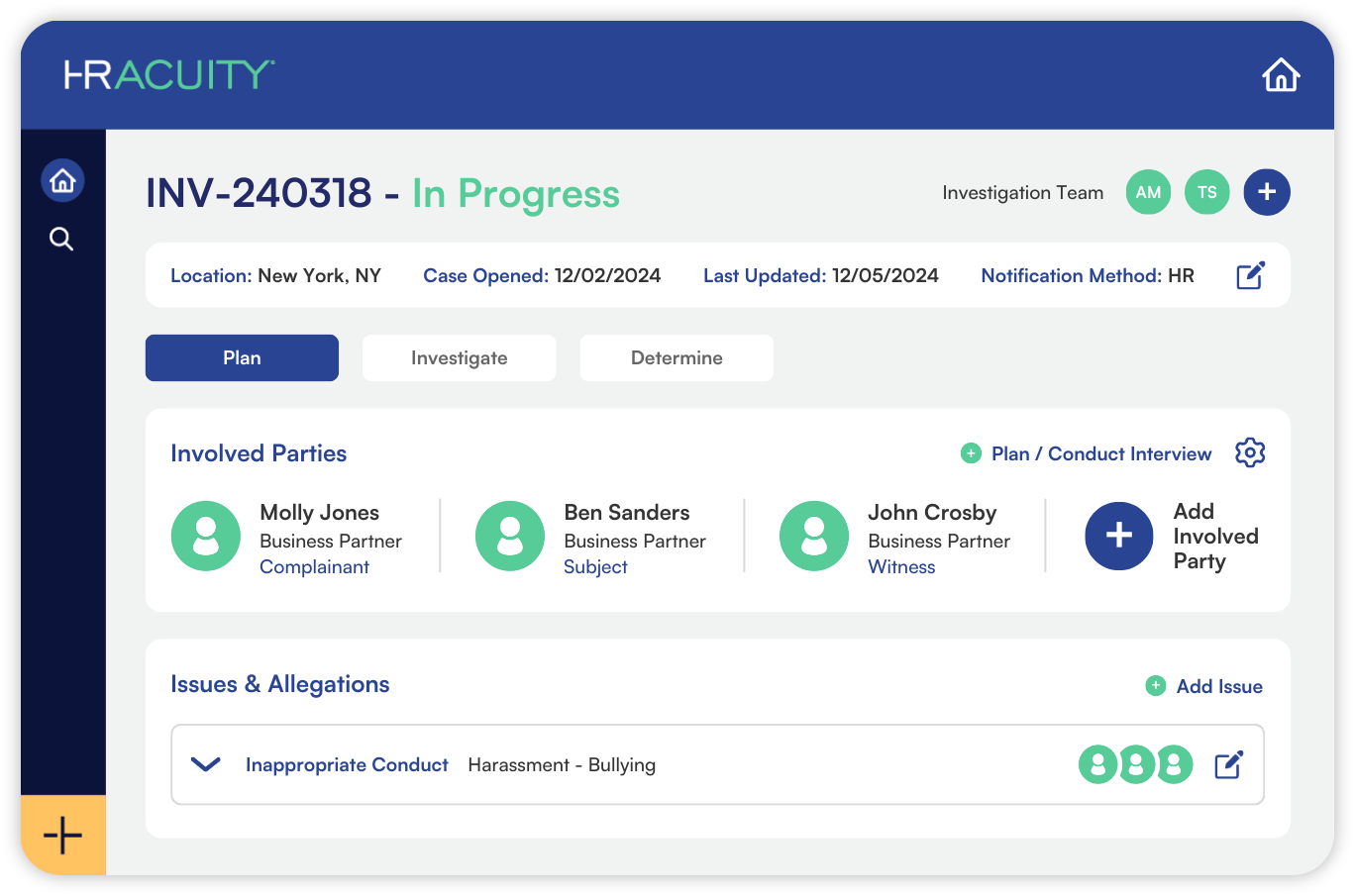
HR Acuity’s employee relations case management platform gives organizations a centralized system to track, manage and resolve workplace issues with the rigor and consistency enterprise risk programs require. With best practice-embedded investigation management and powerful, real-time analytics, HR Acuity helps compliance, HR and risk leaders connect workforce conduct data to broader organizational risk and enables faster, more defensible decisions.
Ready to strengthen your enterprise risk strategy from the inside out? Learn how HR Acuity can help with a personalized demo.