
Most organizations manage employee relations in the dark, relying on gut feelings and scattered spreadsheets. But you can’t improve what you can’t see. By centralizing employee relation data, technology transforms “human issues” into actionable insights — empowering teams to spot patterns before they become crises and prove their financial impact on the bottom line. And that’s important because employee relations is now part of your core risk strategy.
In this blog, we’ll explore how moving away from manual processes to a dedicated employee relations platform protects what matters most: Your people, organization and bottom line.
Key Takeaways: How Employee Relations Tech Boosts ROI in HR
- The ROI of Prevention is Massive: The financial impact isn’t just about software costs; it’s about the “non-event.” Between a 520% three-year ROI and the ability to stem the tide of preventable turnover (which costs up to 250% of a salary), ER technology acts as a high-yield insurance policy for your culture and your bottom line.
- Data Silos are Financial Risks: Relying on spreadsheets and “gut feelings” creates dangerous blind spots. Centralizing ER data transforms human issues into an early warning system, allowing you to spot misconduct patterns before they escalate into costly litigation or PR crises.
- Efficiency is a Strategic Asset: Moving away from manual processes can supercharge team efficacy by 20% and slash reporting time by up to 92%. This reclaims hundreds of hours, allowing ER professionals to move from “paper-chasers” to strategic partners with a seat at the leadership table.
The Role of Employee Relations Technology in Modern Employee Relations
The Ninth Annual Employee Relations Benchmark Study makes one thing clear: The volume of employee issues has reached a breaking point. For the first time in the Study’s history, misconduct and retaliation claims have reached a record high of 14.7 per 1,000 employees. This isn’t just an HR challenge; it is a significant business risk that “intuition” and spreadsheets can no longer contain. Even more concerning is that 68% of organizations fail to track the number of issues per case, creating a blind spot in understanding case complexity.
As the complexity of these cases grows, technology has evolved from a digital filing cabinet into a critical “early warning system.” The data reveals a dangerous gap: 32% of organizations still operate without a required, standardized investigation process. This lack of structure leaves nearly a third of companies exposed to inconsistent outcomes and preventable legal escalations.
Some of the benefits of using employee relations technology are obvious: When employees feel supported, they’re more empowered to speak up about issues like mental health and workplace harassment, and their voices bring what have traditionally been taboo issues to light.
But what about from a business and ROI perspective? Can the implementation of ER technology save organizations time and money, and help to elevate the function of HR as a strategic business driver?
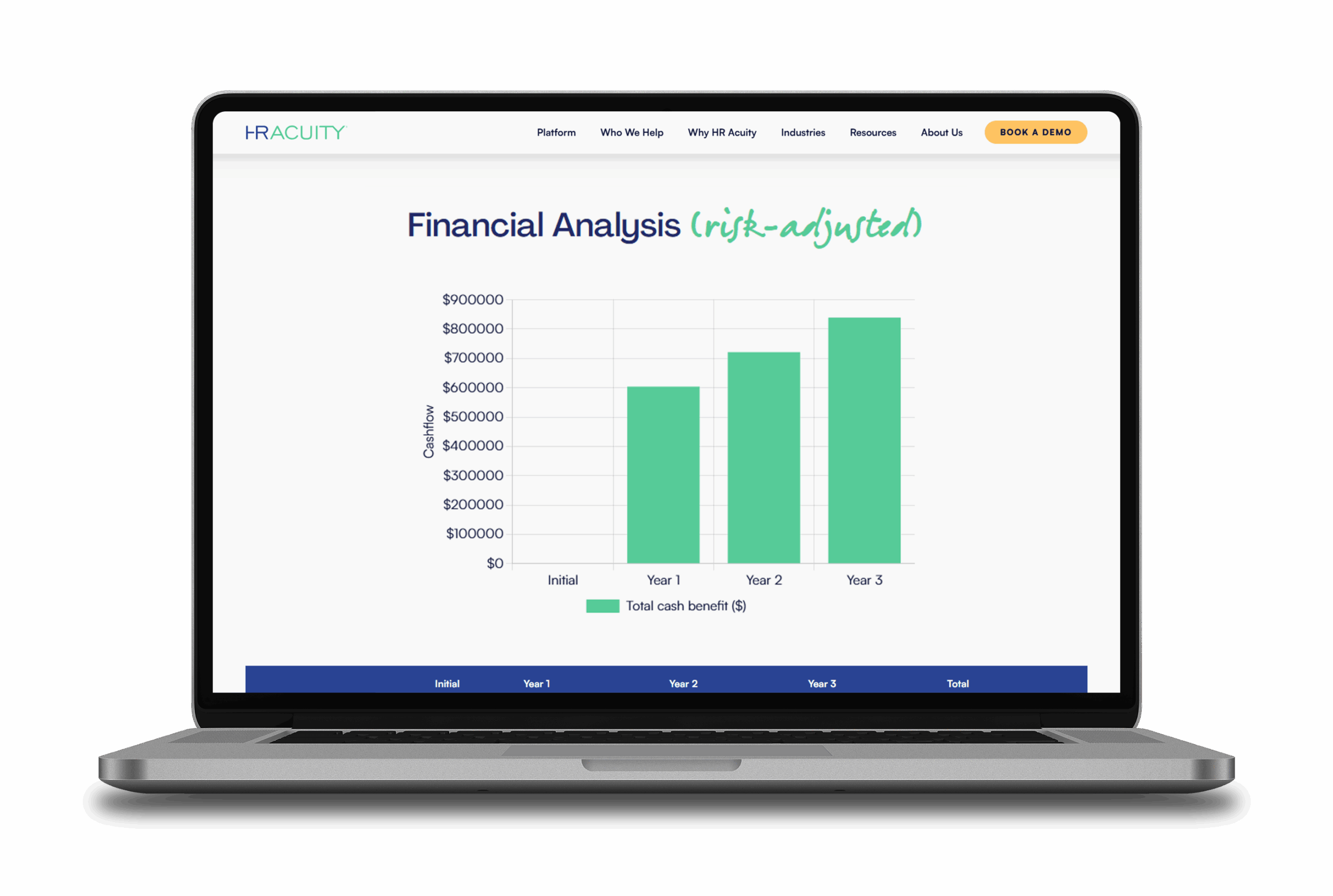
To help employee relations professionals build a bulletproof business case, HR Acuity commissioned a Forrester Consulting Total Economic Impact™ (TEI) study. The results were definitive: The platform delivered a 520% ROI over three years, proving that the initial investment in ER technology is vastly outweighed by the millions saved in risk mitigation and operational efficiency.
Quantifiable Ways Employee Relations Technology Boosts ROI
The Forrester Total Economic Impact™ study highlights three key pillars where HR Acuity’s employee relations technology transforms the bottom line:
- Minimizing Organizational Risk: Standardized investigations and airtight documentation are your best defense. By moving away from “lost” notebooks and fragmented emails, organizations protect themselves from costly missteps and litigation that can spiral into the millions. Just ask Grifols.
- Stemming the Tide of Turnover: When employees feel heard and issues are resolved fairly, they stay. The financial stakes are massive: Turnover costs can range from 30% to as high as 250% of an employee’s salary. Since 42% of turnover is preventable, employee relations technology provides the “early warning” data needed to fix culture issues before your most expensive talent walks out the door.
- Supercharging Team Efficiency: Centralizing data eliminates the “manual grind.” According to Forrester, employee relations teams using HR Acuity saw a 20% increase in efficacy, replacing hours of report-building and paper-chasing with easy-to-use dashboards. Waymo, an HR Acuity customer, now completes reporting 92% faster than it did before with the support of employee relations technology.
By reclaiming this time, employee relations professionals finally earn their “seat at the table.” With data-backed insights into the employee experience, organizations can intervene earlier, protecting both their talent and their institutional knowledge.

Making the Business Case for Employee Relations
Building a bulletproof business case for ER technology requires shifting the conversation from “HR efficiency” to “organizational resilience.” When employee relations is treated as a strategic asset rather than a support function, the organization gains the foresight needed to protect its brand and bottom line. And employee relations teams get the technology they need.
Identifying the Symptoms: Why Modern Workplaces Are Struggling
Before presenting the solution, it’s important to quantify the cost of “standing still.” Organizations relying on legacy systems, like spreadsheets, file cabinets or unsecured email threads, often face a specific set of risks that erode trust and value:
- Inconsistency in Case Handling: Without standardized workflows, outcomes vary based on the investigator, leading to knowledge gaps when experienced team members leave.
- Lack of Actionable Data: Manual tools fail to surface trends, meaning teams cannot act on “hotspots” or recurring patterns before they escalate.
- Missed Follow-ups: When next steps aren’t clearly flagged, important follow-through slips, increasing the risk of retaliation claims or procedural missteps.
- Visibility Gaps: If the impact of employee relations work cannot be measured, the function cannot prove its financial value to senior leadership.
Tailoring the Value Proposition to Stakeholders
A successful business case speaks the language of every department involved in the buying journey.
| Stakeholder | Key Value Driver |
| C-Suite | Gain a “single source of truth” that connects people data to business outcomes and protects the company’s reputation. Get visibility into organizational risks that would otherwise stay invisible. |
| Legal & Compliance | Reduce exposure through centralized, version-controlled records and defensible, audit-ready documentation. |
| IT & Technology | Ensure data security with role-based access and seamless, two-way integrations with existing HRIS platforms like Workday or SAP. |
| DEI Leaders | Use data-driven insights to identify bias trends and provide safe, anonymous reporting options for employees. |
Proving Scalability: A Solution for Every Stage of Growth
A critical part of your business case is demonstrating that the technology will grow with the company.
- Smaller & Surging Companies: Build a strong foundation early to ensure confident scaling as policies and risks become more complex.
- Mid-sized Organizations: Drive efficiency without compromising the fairness or compliance necessary to maintain employee trust.
- Large Enterprises: At this level, there is no margin for error; manual processes simply cannot keep pace with thousands of employees and strict regulatory requirements.
Critical Evaluation: Choosing a “Future-Proof” Platform
To finalize the case, you must demonstrate that the chosen software is not just a “point solution” but a long-term fit. When evaluating vendors, pose these high-impact questions to ensure the investment is sound:
- Is the AI Defensible? Can the platform explain how AI-powered summaries are generated, and is human control always maintained?
- Does it Support External Collaboration? Can you grant secure, role-based access to outside counsel or third-party investigators without breaking the audit trail?
- Is the Syncing Seamless? Does the platform offer “out-of-the-box” two-way integration with your HRIS to prevent manual data entry errors?
- Does it Offer Benchmarking? Can you compare your internal case trends against anonymized data from similar organizations to see how you truly measure up?
Common Mistakes When Calculating ROI in Employee Relations Technology
When calculating ROI, it’s easy to get lost in the spreadsheets and miss the bigger picture. Many employee relations leaders make the mistake of focusing solely on direct costs like software fees or headcount while ignoring the “invisible” expenses that drain a budget.
Here are the most common pitfalls to avoid when building your business case:
Ignoring the Value of Risk Mitigation
Perhaps the costliest mistake is treating risk mitigation as an abstract concept rather than a line item. In employee relations, the most significant ROI often comes from the “non-event” — the lawsuit that never happened, the demand letter that was never sent and the systemic harassment issue that was caught before it hit the headlines. When you fail to put a value on these avoided costs, you’re essentially telling leadership that your department only has value when things go wrong. High-impact ROI means proving that a proactive, tech-backed approach is an insurance policy that pays for itself by keeping the organization out of the courtroom.
Focusing Only on the “Hard” Costs
The biggest mistake is looking only at the price tag of a solution rather than the cost of the problems it solves. If you aren’t accounting for the hundreds of hours your team spends on manual data entry or the massive legal fees from a single mishandled case, you aren’t seeing the full picture. True ROI includes the “soft” savings, like reclaimed time and reduced risk.
Overlooking the Price of Inconsistency
Calculating ROI based on a “best-case scenario” is a trap. In the real world, inconsistency is expensive. When different managers handle similar issues in different ways, it creates a trail of documentation that is impossible to defend in court. Failing to factor in the cost of potential litigation or settlement payouts means your ROI calculation is missing its most significant variable.
Ignoring the Turnover Loop
Many organizations treat turnover as an inevitable cost of doing business, but as we’ve seen, it’s often a preventable one. If your ROI model doesn’t link ER efficiency to improved retention, you’re leaving money on the table. A healthy culture is a financial asset. When you fail to quantify how better issue resolution keeps your best people from leaving, you undervalue the entire ER function.
Frequently Asked Questions: Employee Relations Tech & ROI
1. We already have an HRIS (like Workday or SAP). Why do we need a separate employee relations platform?
While an HRIS is great for managing employee records and payroll, it isn’t built for the complexities of investigations. Generic “notes” fields lack the required security, version control and standardized workflows needed for a legal defense. Employee relations technology provides a defensible audit trail and specialized analytics that a standard HRIS simply can’t match. It isn’t a matter of replacing your HRIS; employee relations technology should be used in tandem with your HRIS. The best employee relations tech actually integrates seamlessly with your HRIS.
2. How do you quantify the ROI of “preventing” a lawsuit?
We look at the “cost of the non-event.” By using the Forrester Total Economic Impact™ methodology, we calculate the average cost of legal settlements, outside counsel and lost productivity from a single mishandled case. When the technology helps you spot a pattern of misconduct early, you aren’t just saving on software; you’re potentially avoiding a multi-million dollar litigation or a PR crisis.
3. Does this technology actually reduce turnover, or just track it?
It does both. You can’t fix what you can’t see. By centralizing data, the platform acts as an early warning system, identifying “hotspots” or specific managers with high grievance rates. This allows HR to intervene with training or mediation before employees quit, directly impacting the 42% of turnover that, according to Gallup, is statistically preventable.
4. How much time can my team really save by switching from spreadsheets?
On average, teams see a 20% increase in overall efficacy. Specifically, for tasks like compliance reporting and data visualization, some organizations (like Waymo) have reported completing their reporting 92% faster. This shifts your employee relations team’s time from manual data entry to strategic human-centric work.
5. Is the AI used in these platforms “safe” for sensitive legal matters?
Yes, provided the AI is defensible and transparent. A future-proof platform ensures that AI is used to summarize and surface insights, but human control is always maintained. The ROI here comes from the speed of analysis without sacrificing the integrity of the investigation.
6. What is the “cost of doing nothing?”
Standing still is a financial risk. Without a standardized process, you face inconsistent case handling, which is a goldmine for plaintiff attorneys. The cost of doing nothing includes rising turnover (which costs 30%–250% of a salary per person) and the high probability of “knowledge loss” when a manual investigator leaves the company.
Try HR Acuity’s ROI Calculator Tool
Numbers tell the most compelling story, but you shouldn’t have to build a complex financial model from scratch. Try HR Acuity’s ROI Calculator Tool to translate your specific organizational data into clear, boardroom-ready savings. It’s the fastest way to see exactly how much manual processes are costing you and how much a dedicated platform can save.
Once you’ve seen the potential impact on your bottom line, get a demo to see the platform in action. Our team will walk you through the features that matter most to your business, helping you transition from managing in the dark to leading with data-driven confidence.