
Documenting employee relations issues in the workplace is essential for consistently gathering the data you need to improve the employee experience and manage organizational risk. Clear documentation helps leaders identify patterns, respond appropriately to concerns and make informed decisions that align with company values, policies and legal obligations.
Today, we’ll walk you through 50 employee relations issues worth documenting. While no single list can capture every possible scenario, these examples represent many of the challenges HR and people leaders encounter most often. From performance concerns and policy violations to interpersonal conflicts and workplace conduct issues, proper documentation creates clarity, accountability and continuity over time.
We do want to note: This list is not meant to be exhaustive. Employee relations challenges continue to evolve alongside changes in the workforce, workplace norms and business realities. Consider this a practical starting point…one that can be adapted, expanded and refined as new situations arise and organizations grow.
Let’s dive in.
Key Takeaways: Employee Relations Issues to Document
- Document consistently: Many routine employee relations issues — not just major incidents — should be documented to ensure fairness, clarity and legal protection.
- Cover the full employee lifecycle: Documentation should span performance, conduct, attendance, policy violations, complaints and disciplinary actions.
- Enable better decisions: Strong records help identify patterns, support investigations and reduce risk while improving overall workforce management.
What are Workplace Issues?
Workplace issues are situations, behaviors or conditions that disrupt how work gets done or impact the employee experience. They can affect individual performance, team dynamics, workplace culture or an organization’s ability to operate effectively.
Some issues are visible and immediate, like attendance problems or conflicts between employees, while others develop quietly over time, such as burnout, disengagement or inconsistent management practices.
What Types of Workplace Issues Exist?
These issues often fall into several broad categories, including performance, conduct, communication, compliance and interpersonal relationships. Left unaddressed, even small concerns can escalate into larger problems, creating legal risk, eroding trust or damaging morale. What starts as a minor misunderstanding or policy violation can quickly become a pattern if it isn’t documented and managed consistently.
Why is Addressing Workplace Issues Important?
Workplace issues matter because they shape how employees experience their jobs and how organizations protect themselves. Addressing them early (and documenting them clearly!) helps ensure fairness, accountability and transparency. It also gives leaders the data they need to make better decisions, apply policies consistently and intervene before issues become costly or disruptive.
Ultimately, workplace issues are unavoidable in any organization that employs people. What separates strong organizations from struggling ones is not the absence of problems, but how effectively they recognize, document and respond to them.
What are the Top 50 Employee Issues You Should Be Documenting?
These examples of employee issues will help you determine the scenarios you should be documenting, investigating, and reporting on in the workplace. You should consider documenting to better recognize when your employee:
- Gets into a dispute with a co-worker
- Has hygiene problems that can no longer be ignored
- Views sexually explicit material over the company’s internet
- Frequently uses the phone or the internet for personal reasons
- Lacks attention to detail in their work
- Is slow to get their work done, missing assignments and quotas
- Receives poor customer feedback
- Has a dip in expected sales production
- Struggles during the probationary or training period
- Covers up for a co-worker
- Has a hard time following through and never seems to get anything done
- Uses company equipment or facilities without proper authority
- Works unapproved overtime
- Has poor time management skills
- Has excessive unscheduled absences from work
- Is frequently late for work
- Proselytizes religious or political beliefs to co-workers or subordinates
- Comes and goes as they please
- Uses the company credit card for personal expenditures, even if they pay it back
- Calls the women in the office “dear,” “sweetie” and “girls”
- Has “one-too-many” at the company holiday party
- Doesn’t have the required technical skills to get the job done
- Shows up inappropriately dressed or with questionable body piercing/art
- Has inadequate problem-solving skills
- Demonstrates weak written or oral communication skills
- Keeps office space a mess
- Violates a safety rule, even if no one gets hurt
- Swears – either in casual conversation or when things get heated
- Frequently sends, receives, and forwards inappropriate jokes over e-mail
- Is the office bully and creates a hostile work environment
- Makes discriminatory comments or racial epithets, even once
- Has a tendency to have “elevator eyes” when talking to women
- Gossips – all day long
- Displays a lack of commitment to their job or the company
- Carelessly leaves confidential information out in the open
- Can’t seem to get along with anyone on the team
- Makes a veiled threat of physical harm to a co-worker
- Neglects to communicate to management what they are doing
- Appears to have an alcohol or drug problem that is influencing their work
- Cannot accept constructive criticism
- Shows a lack of respect when speaking to their supervisor
- Is using AI in a way that’s misaligned with company policy
- Is constantly late for meetings
- Always has an excuse for not getting things done
- Shares confidential or proprietary information
- Has an unwillingness to confront problems head-on
- Displays hostile or intimidating behavior that negatively affects morale
- Works remotely but never seems to be reachable when needed
- Is being placed on a performance plan or receiving a disciplinary warning
- Is exiting the business either voluntarily (resignation) or involuntarily (termination)
Proper and timely documentation of these employee relations issues protects your organization and provides clear expectations to your employees. HR Acuity’s case management software equips you with built-in tools to better document, investigate and report on hostile workplace issues.
Best Practices for Handling Workplace Issues
It’s no secret that some workplace issues are more difficult to handle than others, but by implementing these best practices, you can figure them out equitably.
Document early and objectively: Capture facts as soon as an issue arises, focusing on behaviors, dates and outcomes rather than assumptions or opinions.
Be consistent in documentation: Apply the same standards, language and level of detail across all cases to ensure fairness and reduce risk.
Centralize records in an HR case management platform: Store all employee relations issues in one secure system to improve visibility, continuity and follow-through. Need help deciding which HR case management platform is right for you? Check out this ultimate guide to the best HR case management software.
Use clear, plain language: Write documentation so that anyone reviewing the case later can easily understand what happened, why it matters and what actions were taken.
Track patterns, not just incidents: A single issue may seem minor, but patterns over time often reveal larger concerns that need intervention.
Separate facts from outcomes: Clearly distinguish between what occurred, the policy or expectation involved and the resolution or next steps.
Maintain confidentiality and access controls: Ensure sensitive information is only visible to appropriate stakeholders within your case management system.
Close the loop: Document follow-ups, employee responses and final resolutions to demonstrate accountability and completeness.
Align documentation with policy: Reference relevant company policies or standards to reinforce consistency and defensibility.
Use data to improve the employee experience: Leverage insights from documented cases to identify trends, training needs and opportunities for organizational improvement.
Discover how HR Acuity Can Help You Handle Employee Issues the Right Way, Every Time
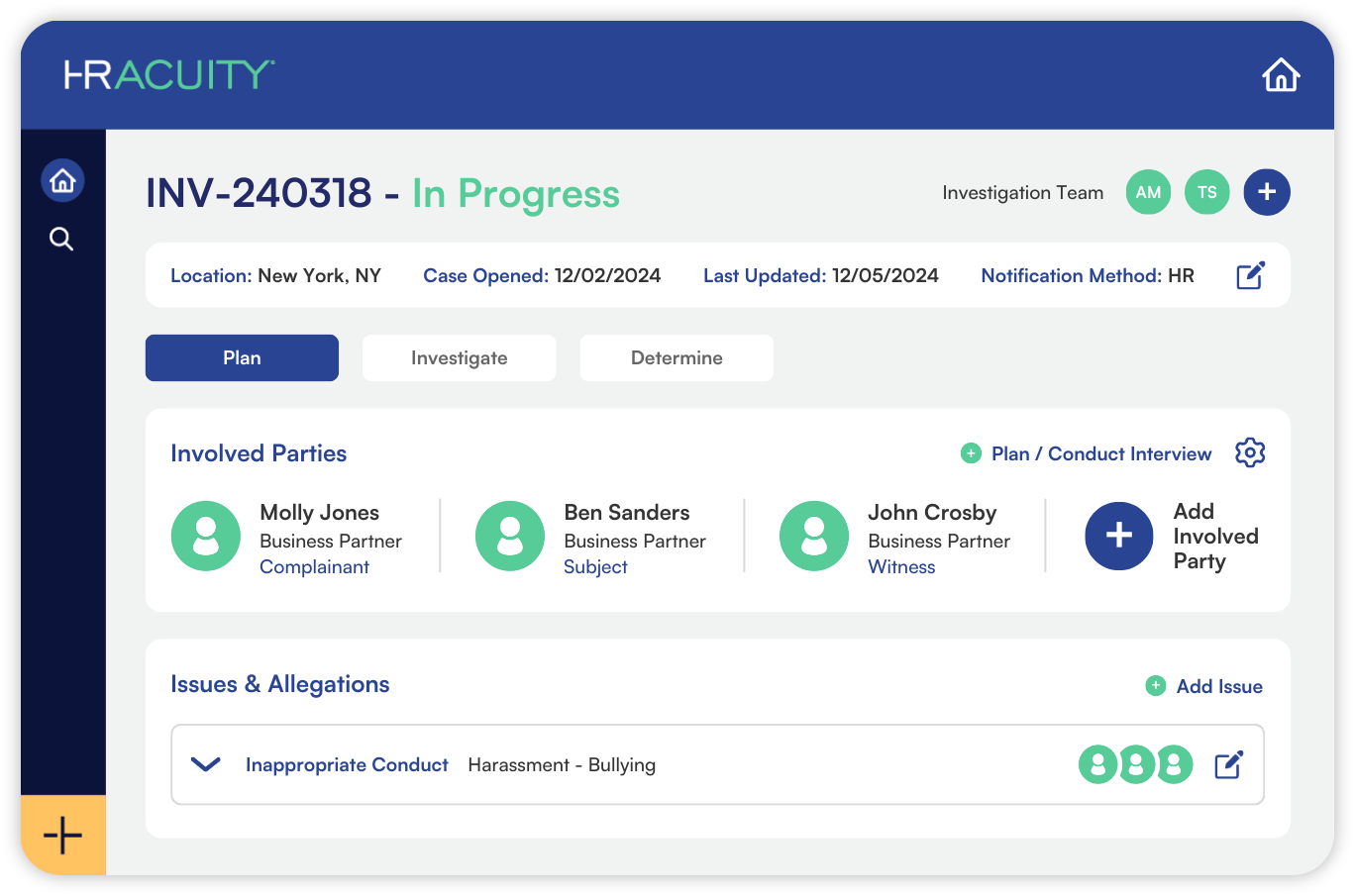
Proper and timely documentation of these employee relations issues protects your organization and provides clear expectations to your employees. HR Acuity’s documentation software equips you with built-in tools to better document, investigate and report on hostile workplace issues.
Watch the video below to learn tips for reducing risk and boosting employee experience at your organization:
Looking for an easy-to-use process for documenting everyday employee relations issues like these? Let us demonstrate what HR Acuity can do for your organization. Get a demo today.